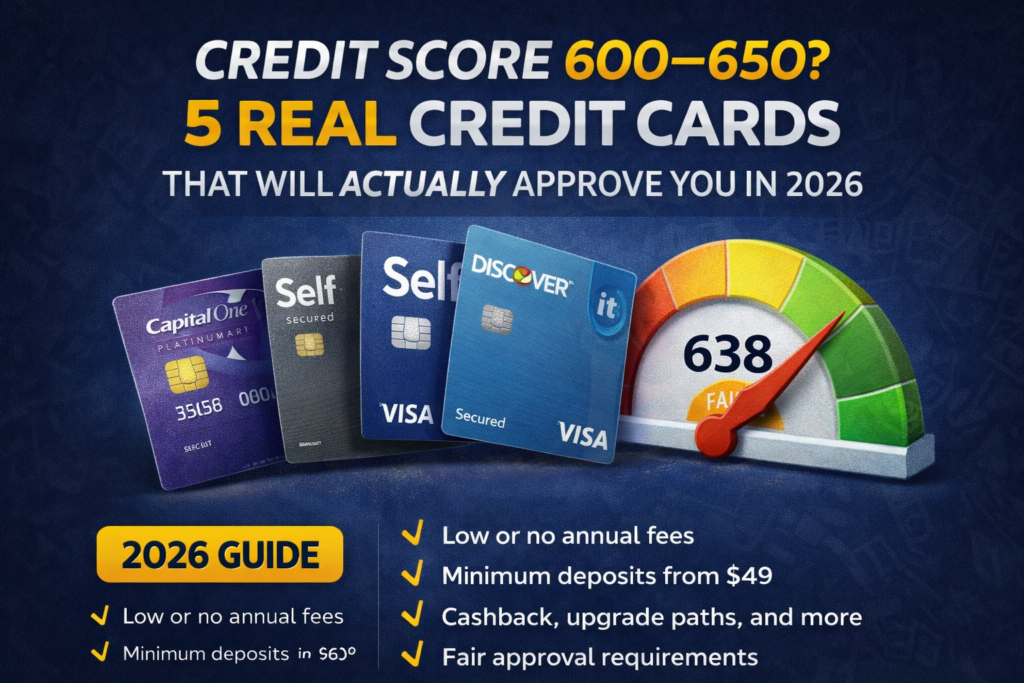
You have a 638 credit score. You’re not in crisis mode — no collections, no bankruptcies. You just made some mistakes, carried some balances, maybe missed a few payments years ago. But every time you apply for a “decent” card, you get rejected. And every “bad credit” list you read is full of cards for people with scores 500 and below — predatory fees, no rewards, no path to upgrade. You’re stuck in credit limbo. This article is your exit ramp.
According to Bankrate, consumers with scores between 600 and 650 sit in the most critical transition zone — many are still rejected for traditional unsecured cards, but already qualify for far better terms than the predatory products aimed at lower scores. [citation:5]
The Truth About a 600–650 Score
Not all “fair credit” is the same. Your strategy changes depending on where you fall.
| Score | FICO Category | Card Access | Recommended Strategy |
|---|---|---|---|
| 300–579 | Poor | Entry-level secured only | Deposit and build from zero |
| 580–619 | Fair/Poor | Secured + some expensive unsecured | Secured with upgrade path |
| 620–659 | Fair | Top secured + limited unsecured | Premium secured or basic unsecured |
| 660+ | Good | Most traditional cards | Cashback and travel cards |
Conclusion: If you’re at 600–650, you don’t need a predatory card with a $99 annual fee and no rewards. You need a card that treats you like a future prime borrower — not a permanent resident of bad credit land.
Real Credit Card Options for Scores 600–650
| Card | Type | Minimum Score | Annual Fee | Deposit | Rewards | Upgrade Path? | Best For |
|---|---|---|---|---|---|---|---|
| Capital One Platinum Secured | Secured | 580+ | $0 | $49–$200 | No | Yes | Lowest upfront deposit |
| Discover it® Secured | Secured | 600+ | $0 | $200+ | 2%/1% cashback | Yes | Cashback while rebuilding |
| First Progress Prestige Secured | Secured | 300+ | $49 | $200+ | 1% payments | No | Last-resort approvals |
| Self Visa® Secured | Secured + Loan | 580+ | $0 first year | $0 upfront | No | Yes | Dual credit building |
| Capital One Quicksilver Secured | Secured | 600+ | $0 | $200+ | 1.5% cashback | Yes | Flat-rate cashback |
Capital One Platinum Secured — The Lowest Entry Cost
Why Choose It
This card allows deposits starting as low as $49 for a $200 limit, which is rare in the market. [citation:5]
Pros
- Soft pull pre-qualification
- Lowest deposit requirement
- $0 annual fee
- Possible approval with scores around 580
- Reports to all three credit bureaus
Cons
- No cashback or rewards
- Upgrade not guaranteed
- Low initial limits
Verdict: If you only have $49 available, this is your most realistic option. Simple, stable, and effective.
Discover it® Secured — The Best Cashback for Mid-Level Credit
Why Choose It
One of the only secured cards offering real cashback plus a proven graduation path. [citation:5]
Pros
- 2% cashback at gas stations and restaurants
- 1% on all other purchases
- Cashback Match after the first year
- $0 annual fee
- Free FICO score access
- Automatic upgrade review after 7–8 months
Cons
- Minimum deposit of $200
- Discover acceptance slightly lower internationally
Verdict: This is the gold standard of secured cards. You earn rewards while rebuilding.
First Progress Prestige Secured — The Last Resort
Why Choose It
Approves nearly anyone, even with extremely low scores or major credit issues. [citation:1]
Pros
- Minimum score: about 300
- Soft pull application
- 1% cashback on payments
- Reports to all three bureaus
Cons
- $49 annual fee
- No graduation path
- Mixed customer service reviews
Warning: Use this only if every other door is closed. Plan to replace it within 12–18 months. [citation:1]
Self Visa® Secured — The Two-in-One Builder
Why Choose It
Combines a secured credit card with a credit builder loan for dual credit growth. [citation:5]
How It Works
- Open a Self credit builder loan ($25–$150).
- After three on-time payments, qualify for the secured card.
- Card limit is tied to your loan savings.
- Both loan and card activity report to all three bureaus.
Pros
- No separate deposit for the card
- Builds credit in two categories
- $0 annual fee first year
Cons
- Slightly complex structure
- $25 annual fee after year one
- Loan admin fees apply
Verdict: Excellent for people who want faster score growth with a structured system.
Capital One Quicksilver Secured — The Premium Secured Option
Why Choose It
Offers 1.5% cashback on every purchase, similar to many unsecured cards.
Pros
- 1.5% flat cashback
- $0 annual fee
- $200+ deposit
- Soft pull pre-qualification
- Potential upgrade to unsecured version
Cons
- Higher minimum deposit than Platinum Secured
- Requires slightly stronger profile
Verdict: If you can deposit $200, this feels closest to a traditional cashback card.
First-Year Cost Comparison
| Card | Deposit | Annual Fee | Estimated Cashback ($200/month) | Real Cost | Net Gain |
|---|---|---|---|---|---|
| Capital One Platinum Secured | $49–$200 | $0 | $0 | $0 | $0 |
| Discover it® Secured | $200 | $0 | $48–$72 | $0 | $48–$72 |
| First Progress Prestige | $200 | $49 | $24 | $49 | –$25 |
| Self Visa® Secured | $25–$150 | $0 first year | $0 | $0 | $0 |
| Capital One Quicksilver Secured | $200 | $0 | $36 | $0 | $36 |
Conclusion: Discover it® Secured is the only card that actually pays you while you rebuild. First Progress is the only one that charges you for the privilege.
Approval Reality Check
| Card Type | Typical Approval Odds (600–650) | Risk Level |
|---|---|---|
| Premium unsecured cards | Very low | High rejection risk |
| Basic unsecured cards | Moderate | Mixed results |
| Secured cards with upgrade paths | High | Safest option |
| Last-resort secured cards | Very high | Use cautiously |
For most people in this score range, secured cards with graduation options are the smartest move.
The 12-Month Action Plan for a 600–650 Score
Months 1–3: Entry Phase
- Apply for Discover it® Secured or Capital One Platinum Secured.
- Deposit as much as you comfortably can (ideally $500).
- Set autopay for the full statement balance.
- Use only 10–20% of your limit.
Months 4–6: Building Phase
- Add a second secured card or become an authorized user.
- Keep utilization below 10%.
- Track your FICO score monthly.
Months 7–9: Graduation Phase
- Issuers review accounts automatically.
- Deposit may be returned.
- Card converts to unsecured.
Important: Don’t close the secured card. Keep it for history.
Months 10–12: Transition Phase
- Apply for your first true unsecured rewards card.
- Keep the secured card open.
- Use it once every few months.
By month 12, many borrowers move into the 680+ score range.
You’re officially out of credit limbo.
What NOT to Do with a 600–650 Score
Avoid these common mistakes:
🚫 Don’t apply for store cards.
🚫 Don’t pay annual fees on secured cards unless necessary.
🚫 Don’t close old accounts.
🚫 Don’t carry balances to “build credit.”
🚫 Don’t apply for multiple cards at once.
Every hard inquiry matters at this score level.
Final Takeaway
You don’t have bad credit. You have dormant credit. The difference is that one is permanent — the other is just waiting for the right tools and the right habits.
At SmartCardTip.com, we don’t believe in trapping you in bad credit products forever. We believe in graduated paths, transparent math, and cards that reward you while you rebuild.
👉 Take the 90-second “Credit Limbo Test” and we’ll tell you exactly which of these five cards matches your spending, deposit capacity, and timeline to graduate to premium cards.
This guide was updated for February 2026 by the SmartCardTip.com team. We analyze credit card approval patterns weekly so you don’t waste hard inquiries on cards you’ll never get. Sources: Bankrate, WalletHub, and direct issuer data as of Q1 2026.
Credit score requirements are estimates based on publicly reported data and issuer behavior. Your actual approval odds depend on your full credit profile, income, and existing relationships with the issuer. Pre-qualification tools (soft pull) are your best friend — use them before submitting a full application.