You check your budget at the end of the month and wonder: where did all the money go? You didn’t buy anything big. No vacations, no furniture, no major electronics. Yet the total is much higher than expected. The answer might not be in what you bought, but in how you paid for it.
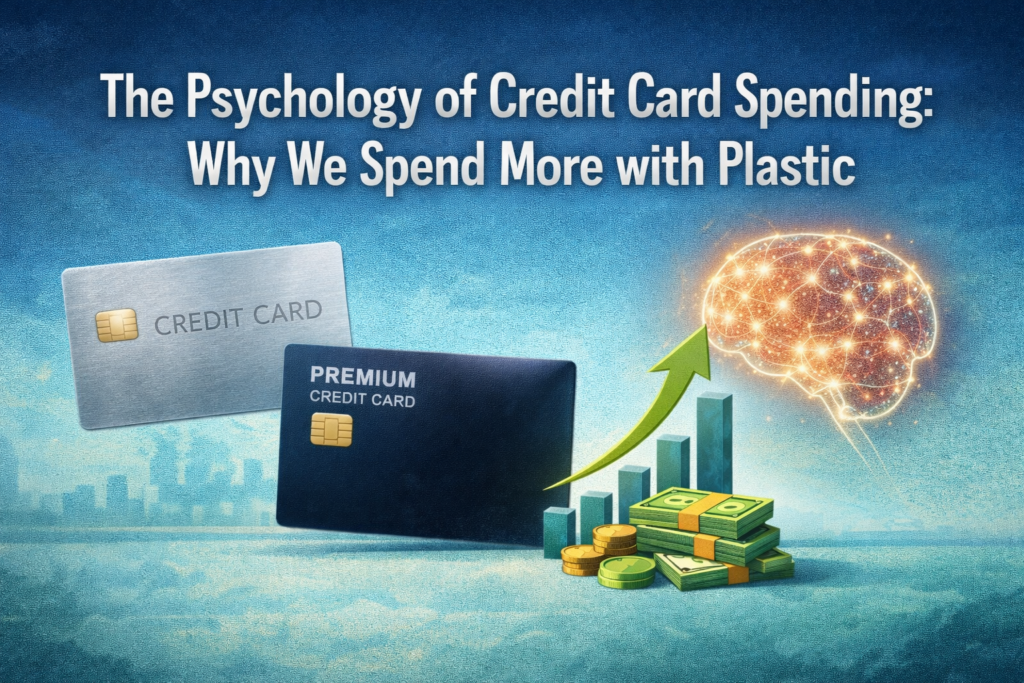
Decades of behavioral economics research show that the method of payment changes how your brain experiences spending. When you use a credit card, your brain processes the purchase differently than when you use cash. The result? Most people spend more with plastic—even when they’re trying to be careful.
Let’s break down the psychology behind that effect.
The Pain of Paying
Behavioral economists use a term called the “pain of paying.” It describes the small but real psychological discomfort we feel when money leaves our hands.
Imagine two scenarios at a restaurant:
- In the first, you pay cash for every bite of food.
- In the second, you eat the entire meal and pay the bill at the end.
In the first case, every bite would feel expensive. You’d probably eat less. In the second, the pleasure of the meal is separated from the moment of payment. You enjoy the food first, and the cost comes later.
Credit cards work the same way.
With cash:
- You hand over physical bills.
- Your wallet becomes lighter immediately.
- Your brain registers the loss in real time.
With a credit card:
- You tap or swipe.
- No money visibly leaves your hands.
- The actual payment happens weeks later.
This separation removes the natural psychological brake that cash creates. Studies in consumer behavior show that when the purchase and the payment are decoupled in time, people feel less discomfort and spend more freely.
The Brain Gets a “Reward”
The effect isn’t just psychological. It’s neurological.
Research using brain imaging at institutions like MIT found that paying with a credit card activates the striatum, a part of the brain associated with reward and pleasure. This is the same region that lights up when you:
- Smell your favorite food
- Win a game
- Anticipate something exciting
In simple terms, the card doesn’t just remove the pain—it can actually create a sense of reward.
When you use plastic:
- The negative signal (loss of money) is muted.
- The positive signal (getting the item) is amplified.
Behavioral scientists sometimes describe this as “removing the brakes and pressing the gas at the same time.” You feel less resistance to spending, and more excitement about the purchase.
That combination is powerful. It makes impulse buying more likely, even among people who consider themselves disciplined.
What We Buy: Benefits vs. Costs
Another fascinating finding from consumer research is that the payment method changes what your brain focuses on.
When you pay with cash:
- Your brain emphasizes the cost.
- You think about the price, the trade-off, and the sacrifice.
When you pay with credit:
- Your brain emphasizes the benefits.
- You imagine how enjoyable, useful, or exciting the item will be.
This shift changes behavior.
With credit cards, people are more likely to buy:
- Entertainment
- Gadgets
- Fashion items
- “Treat yourself” purchases
With cash, people tend to buy:
- Groceries
- Household essentials
- Practical, utilitarian items
The difference isn’t about income or personality. It’s about how the brain frames the transaction. Credit focuses attention on the upside. Cash forces attention on the downside.
That’s why it’s often easy to swipe for something fun in the moment—and much harder to justify the purchase when the bill arrives.
The Illusion of Percentages
Human brains aren’t great at evaluating money in absolute terms. We tend to think in percentages instead.
Behavioral economist Dan Ariely demonstrated this with a simple scenario:
- You’re buying a $15 pen.
- Another store five blocks away sells it for $8.
- You save $7.
Most people say the walk is worth it. You’re saving almost 50%.
Now change the scenario:
- You’re buying a $1,015 suit.
- Another store five blocks away sells it for $1,008.
- You still save $7.
Suddenly, most people say the walk isn’t worth it.
But the savings are identical: $7.
Your brain isn’t evaluating the actual dollar value. It’s reacting to the percentage difference.
Credit cards create a similar illusion.
If your monthly balance is already:
- $1,200
- $1,500
- or even $2,000
Adding another $100 purchase feels small. It’s just a tiny piece of a large total. Your brain interprets it as a minor increase, even though $100 is still $100.
This mental framing reduces resistance to additional spending, especially near the end of a billing cycle.
The Trap of the Minimum Payment
Credit card statements are carefully structured, and one of the most powerful features is the minimum payment option.
On the surface, it looks helpful:
- You don’t have to pay the full balance.
- You can pay a smaller amount and stay in good standing.
But psychologically, it creates a powerful illusion.
When a $600 purchase is presented as:
- $25 per month
- or “just” a small minimum payment
Your brain starts to think of the item as cheaper than it really is. The focus shifts from the full price to the small monthly number.
This masks:
- The true cost of the item
- The effect of interest
- The length of time it will take to pay off
Behavioral studies show that people who see a minimum payment option are more likely to:
- Spend more
- Carry balances
- Take longer to pay off debt
The minimum payment doesn’t just offer flexibility. It changes how your brain perceives the price.
Warning Signs: Are You Being Affected?
You don’t need to have debt to be influenced by these psychological effects. The behavior often shows up long before the financial consequences.
Ask yourself:
- Do you ever feel surprised—or disappointed—by your statement total?
- Do you use your card for small daily purchases without thinking?
- Is it harder to remember the exact price of things you bought with a card?
- Do you often buy items that weren’t planned but felt like a good idea at the time?
- Do you focus more on whether you can afford the payment than on the total cost?
If you answered “yes” to several of these, you’re likely experiencing the behavioral effects of credit card spending.
And that’s normal. These systems are designed to be psychologically frictionless.
Strategies to “Outsmart” Your Brain
The goal isn’t to stop using credit cards entirely. They’re useful tools. But you can change the environment around them so your brain behaves more rationally.
1. Restore the Pain of Paying
Turn on instant notifications for every purchase.
Each time you use your card:
- Your phone buzzes.
- You see the amount immediately.
That small moment of awareness recreates some of the friction that cash provides.
2. Use a Cooling-Off Rule
Set a personal rule:
- Any purchase over $50 requires a 24-hour wait.
- Any purchase over $200 requires a 48-hour wait.
Impulse purchases rely on emotion and urgency. Time weakens both.
3. Convert Prices into Work Hours
Instead of thinking in dollars, think in time.
Ask yourself:
- “If I earn $20 per hour after taxes…”
- “This $200 item equals 10 hours of work.”
- “Is it worth a full day and a half of my life?”
This reframing makes the cost feel more concrete.
4. Separate Planned vs. Daily Spending
Use your card intentionally.
- Big, planned purchases: card is fine.
- Online transactions: card is safer.
- Everyday small spending: consider using cash or a mental “checking account” approach.
For example:
- Set a weekly spending limit.
- Treat it like cash, even if you use a card.
- When the limit is reached, stop spending.
This brings structure back into the system.
Conclusion
Credit cards aren’t inherently good or bad. They’re tools. But they’re also powerful psychological devices.
They:
- Remove the immediate pain of paying
- Activate reward centers in the brain
- Shift attention from costs to benefits
- Make prices feel smaller than they are
- Encourage long-term balances through minimum payments
The goal isn’t to cut up your credit cards. The goal is to understand the silent conversation happening in your brain every time you swipe. By bringing that conversation into the open, you put yourself back in control.
This guide was updated for 2026 by the SmartCardTip.com team. We believe that understanding the “why” behind your spending is the first and most important step toward financial health.