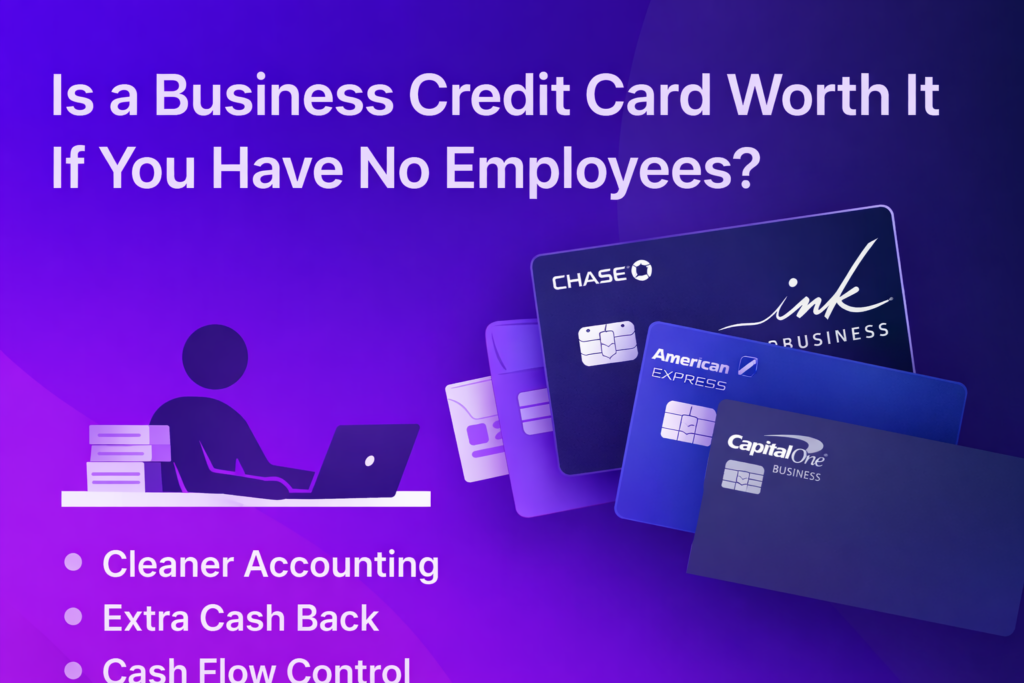
Running a solo business often means one thing: your personal and business expenses are tangled together. Software subscriptions, fuel, ad spend, and equipment all land on the same card you use for groceries. That makes taxes harder, cash flow less predictable, and rewards nearly nonexistent. According to a 2025 Federal Reserve small business report, 43% of owners with no employees still rely on personal credit cards for business spending, even when better options exist.
If you’re a freelancer, consultant, or one-person company, a business credit card isn’t just a convenience. It can be a cash-flow tool, a rewards engine, and a financial firewall between your company and your personal life.
What Counts as a “Business” Card for Solo Owners?
You don’t need employees, an office, or a big revenue stream to qualify. In the U.S., a sole proprietorship automatically exists the moment you start making money from freelance work, online sales, or services.
That means you can apply for a business credit card using:
- Your legal name as the business name
- Your Social Security Number (SSN) instead of an EIN
- Your estimated annual business revenue
According to a 2024 Bankrate survey, 68% of small businesses in the U.S. have no employees, meaning solo entrepreneurs are the majority (Bankrate, 2024). Business credit cards are built with this exact audience in mind.
Why a Business Credit Card Can Make Sense (Even Solo)
1. Cleaner bookkeeping
Separating personal and business transactions reduces accounting errors and tax-time stress.
A 2025 NerdWallet analysis found that small business owners who separate expenses save an average of 8–12 hours during tax preparation (NerdWallet, 2025).
2. Better cash flow control
Most business cards offer grace periods of 21–25 days before interest applies, giving you breathing room between earning revenue and paying expenses.
3. Higher rewards on business categories
Business cards often give bonus rewards on:
- Advertising
- Office supplies
- Internet and phone bills
- Travel and gas
These are categories personal cards don’t always prioritize.
4. Potential credit protection
Many business cards don’t report to personal credit bureaus unless you default, which can help keep utilization off your personal credit report.
According to Forbes Advisor, over 60% of major business credit cards don’t report ongoing balances to personal credit, unlike consumer cards (Forbes Advisor, 2025).
When It Might Not Be Worth It
A business credit card may not make sense if:
- You spend less than $300 per month on business expenses.
- You struggle with credit card debt.
- Your personal credit score is below 580.
In those cases, a secured or starter business card may be a better first step.
Top Business Credit Cards for Solo Entrepreneurs (2026)
Here’s a comparison of three popular options widely available in the U.S. as of 2026.
| Card | Annual Fee | Bonus | Cashback | Interest Rate | Best For |
|---|---|---|---|---|---|
| Chase Ink Business Cash | $0 | $750 after $6,000 spend | 5% in select categories | 18–26% APR | Office, internet, and ads |
| Amex Blue Business Plus | $0 | No large bonus, ongoing rewards | 2x points on first $50k/year | 18–27% APR | Everyday spending |
| Capital One Spark Cash Plus | $150 | $1,200 after $30,000 spend | 2% flat cash back | Charge card (no preset APR) | High-spend solo owners |
Terms and offers may vary by applicant and time.
Card-by-Card Pros and Cons
Chase Ink Business Cash
Best for: freelancers with recurring expenses
Pros
- No annual fee
- 5% cash back on office supplies and internet/phone services
- Large welcome bonus
Cons
- Bonus categories have spending caps
- Foreign transaction fees apply
- Requires good to excellent credit
Amex Blue Business Plus
Best for: simple, everyday spending
Pros
- No annual fee
- 2x points on all purchases up to $50,000 annually
- Strong Amex protections and tools
Cons
- Limited welcome bonus
- Points value depends on redemption method
- Acceptance not as universal as Visa/Mastercard
Capital One Spark Cash Plus
Best for: high-revenue solo operators
Pros
- Unlimited 2% cash back on everything
- Very large sign-up bonus
- No preset spending limit
Cons
- $150 annual fee
- Must pay balance in full each month
- High spending requirement for bonus
Real-World Example: Freelancer Spending $2,000/Month
Let’s say you’re a freelance designer spending:
- $600 on ads
- $200 on software
- $300 on internet and phone
- $900 on equipment and supplies
With the Chase Ink Business Cash, the 5% categories alone could generate:
- $1,100 in 5% spending
- $55 per month in cash back
- About $660 per year, plus the welcome bonus
That’s real money back from expenses you’d already have.
Tax and Accounting Advantages
Using a business credit card helps you:
- Download expense reports
- Categorize spending automatically
- Reduce audit risks
- Prove business-only purchases
According to the IRS Small Business Tax Guide, clear expense separation is one of the most common factors in successful deductions.
For solo owners, that alone can justify having a dedicated business card.
How to Apply with Confidence
Even without employees, you can get approved if you follow these steps.
1. Choose SSN or EIN
- SSN: Perfectly fine for freelancers and sole proprietors.
- EIN: Optional, but useful if you want more separation.
2. Estimate your revenue honestly
You don’t need huge numbers.
Many issuers approve applicants with:
- $1,000–$5,000 annual business revenue
- Good personal credit (670+)
3. Know your credit score
Typical approval ranges:
- 740+: excellent approval odds
- 670–739: good approval chances
- 620–669: possible with some cards
- Below 620: consider secured options
4. Keep your application simple
Use:
- Your legal name as the business name
- Home address as the business address
- “Sole proprietor” as business structure
Key Benefits Solo Entrepreneurs Often Overlook
Purchase protections
Many business cards include:
- Extended warranties
- Purchase protection
- Rental car coverage
Spending insights
You’ll often get:
- Quarterly expense summaries
- Category breakdowns
- Integration with accounting tools
These features are designed specifically for small business owners.
So, Is It Worth It Without Employees?
For most solo entrepreneurs, the answer is yes—and often sooner than they think.
A business credit card helps you:
- Separate finances
- Improve cash flow
- Earn meaningful rewards
- Simplify taxes
If you’re spending even $500 to $1,000 per month on business expenses, the right card can easily pay for itself.
The key is choosing a card that matches your spending habits, not just the biggest bonus.
Final Verdict
If you’re a freelancer, consultant, or running a one-person business, a business credit card is more than a perk. It’s a financial tool that brings structure, rewards, and flexibility to your operation.
Start with a no-annual-fee option, build a clean expense history, and upgrade as your revenue grows.
Want more comparisons and updated offers?
Visit SmartCardTip.com to explore the best business credit cards for your situation.
This guide was updated for 2026 by the SmartCardTip.com team. We analyze dozens of credit card offers weekly so small business owners don’t have to.