
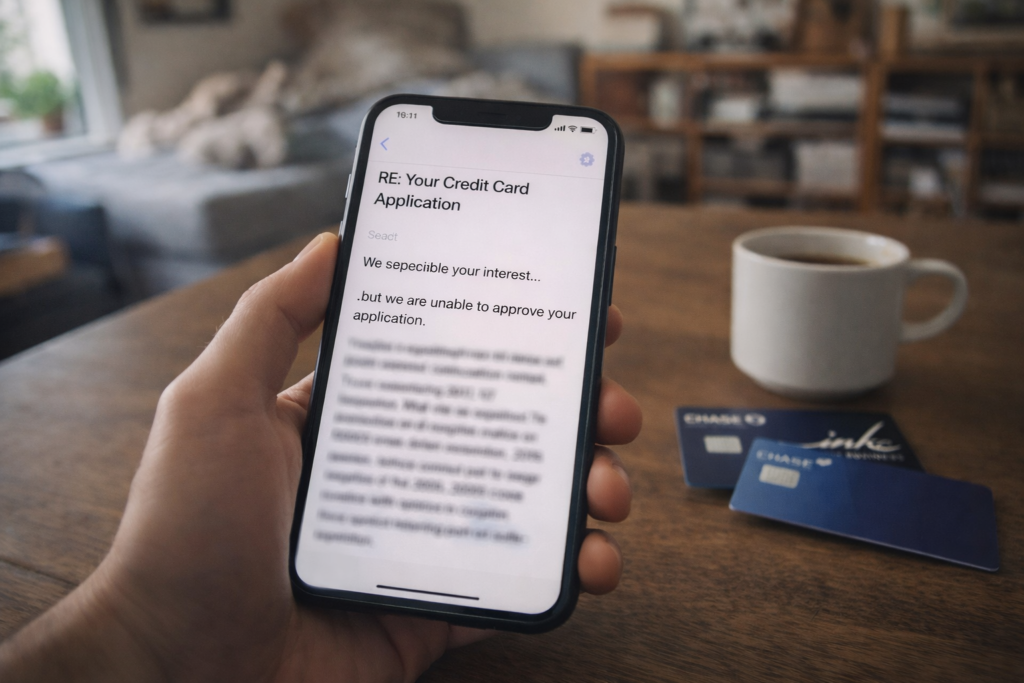
You checked your email.
“We appreciate your interest… but we are unable to approve your application.”
Blank stare. Now what?
If that message felt personal, it’s not. Millions of Americans experience the same thing every year. According to the Federal Reserve’s 2024 Survey of Household Economics, over 20% of credit card applicants were denied at least once in the previous year. And many of them had no idea why.
A 2025 Bankrate study found that nearly 1 in 3 Americans has been rejected for a credit card at some point, often because of issues they didn’t realize were hurting their application. Meanwhile, FICO reports that payment history and credit utilization alone make up 65% of your score, which means small mistakes can have big consequences (FICO, 2025).
The good news? Most denials come from fixable problems.
Below are the 7 hidden reasons your application may have been rejected—and exactly how to correct each one.
1. Your Credit Score Was Below the Card’s Requirement
This is the most obvious reason—but it’s rarely the only one.
Many premium cards require:
- 740+ for excellent credit
- 670–739 for good credit
- 580–669 for fair credit
According to NerdWallet (2025), about 34% of denied applicants had credit scores below the issuer’s target range.
How banks see this
A lower score signals higher default risk. The bank assumes you may miss payments or carry high balances.
Real example
You apply for a travel rewards card requiring a 720 score.
Your score: 655.
Instant denial—even if your income is solid.
How to fix it
- Pay all bills on time for the next 3–6 months
- Reduce credit card balances
- Avoid new credit applications
Most people can see 20–40 point improvements within 90 days with consistent payments.
2. Your Income Was Too Low or Unstable
Credit cards aren’t just about credit scores. Banks also evaluate whether you can realistically repay the balance.
The CFPB reported in 2025 that over 25% of credit card denials involved income or ability-to-pay concerns.
How banks see this
If your income doesn’t support your current debt—or fluctuates heavily—the issuer sees risk.
Real example
You report:
- $18,000 annual income
- $9,000 in existing credit card balances
The bank assumes you’re already stretched thin.
How to fix it
- Wait until your income is more stable
- Include all eligible income:
- Freelance work
- Spouse income (if accessible)
- Side gigs
- Apply again in 3–6 months
3. Too Many Recent Hard Inquiries
Every time you apply for credit, a hard inquiry appears on your report.
According to FICO, consumers with 6 or more inquiries are up to 8 times more likely to default than those with none (FICO, 2025).
How banks see this
Multiple applications in a short time look like financial distress.
Real example
You apply for:
- 2 credit cards
- 1 auto loan
- 1 store card
…all within two months.
That’s four inquiries—big red flag.
How to fix it
- Stop applying for new credit
- Wait 3–6 months
- Use pre-qualification tools instead
4. Your Credit History Is Too Short (Thin File)
Even if your score looks decent, a short credit history can trigger denials.
According to the Federal Reserve, about 26 million Americans are “credit invisible”, meaning they have little or no credit history.
How banks see this
No history = no proof you can handle credit.
Real example
You have:
- One credit card
- Opened 6 months ago
- Perfect payment record
Still denied for a premium card because your file is too new.
How to fix it
- Keep your current card open
- Use it lightly
- Pay on time for 6–12 months
- Consider a second beginner card
5. Your Credit Utilization Was Too High
Credit utilization = how much of your available credit you’re using.
Example:
- Limit: $5,000
- Balance: $4,000
- Utilization: 80%
That’s risky in the eyes of lenders.
According to FICO, consumers with utilization above 50% are far more likely to be denied than those below 30%.
How banks see this
High balances signal financial stress—even if you pay on time.
Real example
You have:
- $10,000 total credit limits
- $7,500 in balances
Score drops. Application denied.
How to fix it
- Pay balances down below 30% utilization
- Ideally below 10%
- Wait 30–60 days for score updates
6. Errors on Your Credit Report
Mistakes are more common than people think.
According to a 2024 CFPB report, 1 in 5 consumers finds at least one error on their credit report.
How banks see this
They don’t. They just see the data—and deny based on it.
Real example
Your report shows:
- A late payment that never happened
- A collection account that isn’t yours
Instant denial.
How to fix it
- Get your reports from:
- AnnualCreditReport.com
- Look for:
- Late payments
- Unknown accounts
- Wrong balances
- File a dispute with:
- Experian
- Equifax
- TransUnion
Disputes are usually resolved within 30 days.
7. The Bank’s Internal Rules (Hidden Policies)
Every issuer has internal approval rules most people never see.
Examples:
Chase 5/24 Rule
If you’ve opened 5 or more cards in 24 months, Chase usually denies you.
Bank of America Relationship Rule
They often favor applicants who:
- Already have accounts with them
- Or keep higher balances
How banks see this
They want long-term customers—not people chasing bonuses.
Real example
You apply for a Chase card:
- Score: 750
- Income: $80,000
- But you opened 6 cards in the past 2 years
Denied instantly.
How to fix it
- Check issuer-specific rules
- Wait until you’re under the limit
- Apply strategically
Typical waiting period:
- 3–12 months, depending on the rule
What Should You Do RIGHT NOW?
Here’s a simple checklist you can follow today—no cost required.
1. Pull your free credit reports
Go to:
AnnualCreditReport.com
Download all three reports.
2. Check your credit score
Use free tools from:
- Your bank
- Credit Karma
- Experian
3. Look for errors and dispute them
If you see mistakes:
- File disputes online
- Most cases resolve within 30 days
4. Use pre-qualification tools
Before applying again, use:
- Chase pre-approval
- Capital One pre-approval
- Amex pre-qualification
These don’t hurt your credit score.
5. Call the reconsideration line
If you were just denied:
- Call the bank within 30 days
- Ask for reconsideration
Example script:
“I recently applied for your card and was declined. I’d like to see if you can review my application again.”
This works more often than people think—especially if the issue was minor.
Final Thoughts
A credit card denial doesn’t mean you’re bad with money. It usually means something in your profile didn’t match the bank’s approval formula.
The key is to:
- Understand the real reason
- Fix it with a clear timeline
- Apply again strategically
Before you submit your next application, check which cards you’re most likely to qualify for. At SmartCardTip.com, we track approval difficulty and update recommendations monthly based on real user data—so you don’t waste another hard inquiry.
This guide was updated for 2026 by the SmartCardTip.com team. We analyze approval patterns and credit card policies so you never waste a hard inquiry again.