You spent $12,000 last year on printer toner, legal pads, shipping boxes, and a new monitor. Your credit card gave you 1% back — $120. But a specialized office supply card could have given you $240, plus a $750 bonus, plus extended warranty on every laptop you bought. You didn’t just lose $120. You left $800 on the counter at Staples.
The average American small business spends between $1,200 and $3,000 per year on office supplies, according to the National Office Products Alliance (NOPA). Businesses with 5–20 employees frequently exceed $15,000 annually once you factor in tech, furniture, and recurring consumables. At those levels, the difference between a 1% and a 5% card isn’t a detail. It’s real money.
The Best Business Cards for Office Supply Cashback in 2026
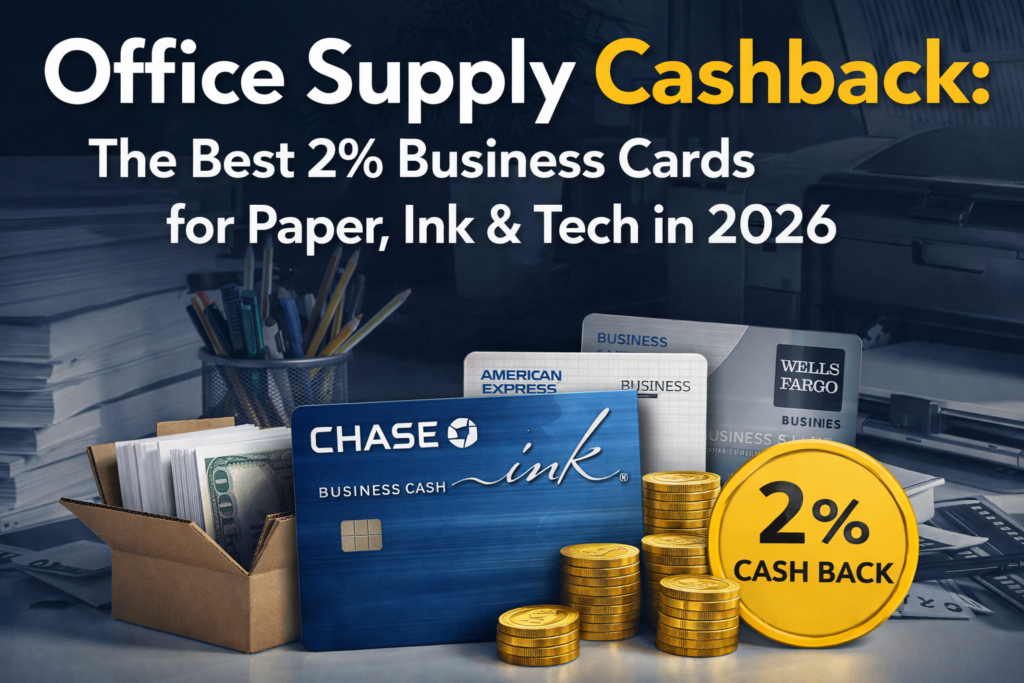
Here are the main U.S. business cards offering 2% or more effective return on office-related spending in 2026.
| Card | Cashback in Office Supplies | Categories Covered | Annual Fee | Bonus | Best For |
|---|---|---|---|---|---|
| Chase Ink Business Cash | 5% (first $25k/year) | Office, internet, phone, cable | $0 | $750 | Heavy office spending |
| Amex Blue Business Plus | 2% (first $50k/year) | All purchases | $0 | 15k points | Simplicity |
| Capital One Spark Cash Select | 1.5% unlimited | All purchases | $0 | $500 | Flat cashback users |
| Wells Fargo Signify Business Cash | 2% unlimited | All purchases | $0 | $500 | Wells Fargo clients |
| Bank of America Business Advantage | 3% (choose one category) | Office, gas, travel, tech | $0 first year, $95 after | $500 | BoA Preferred Rewards |
| U.S. Bank Business Leverage | 4% (rotating category) | Rotating quarterly | $0 | $600 | Planned spending |
For pure office supply rewards, one card stands above the rest.
Why the Chase Ink Business Cash Dominates This Category
No card beats 5% on office supplies. Period.
The Chase Ink Business Cash offers 5% cash back on the first $25,000 spent per year on office supply stores, internet, cable, and phone services. That’s $1,250 cash back from this category alone. And it compounds with the $750 welcome bonus.
Here’s a real-world scenario:
- Annual office supply spend: $10,000
- Cashback at 5%: $500
- Welcome bonus: $750
- First-year total: $1,250
Now compare that with a flat 2% card:
- $10,000 × 2% = $200 cashback
Advantage with Chase Ink: $1,050 more in the first year.
For businesses with recurring supply purchases, this isn’t optimization. It’s a structural advantage.
Store Card vs. Generic 2% vs. Specialized 5%
Many businesses get pitched a store-branded card at checkout. On paper, it looks competitive. In practice, the math tells a different story.
| Criteria | Store Card (e.g., Staples MC) | Generic 2% Card (Amex BBP) | Specialized 5% Card (Chase Ink) |
|---|---|---|---|
| Cashback in-store | 5% (Staples only) | 2% | 5% |
| Cashback elsewhere | 1% | 2% | 1% |
| Acceptance | Mastercard network | Amex network | Visa (wide acceptance) |
| Welcome bonus | $25–$50 | ~15k points (~$200) | $750 |
| Annual fee | $0 | $0 | $0 |
| Works at local paper store? | No | Yes | Yes |
| Works at Amazon/online? | 1% | 2% | 1% (except office stores) |
If you buy all your supplies from Staples, the Staples card wins.
If you buy from anywhere else — Amazon, local suppliers, Office Depot, Walmart — the Chase Ink Business Cash is mathematically superior.
The Hack — How to Get 5% on Every Office Purchase
There’s a simple strategy that experienced business owners use to expand that 5% category.
Step-by-step:
- Go to a Staples, Office Depot, or OfficeMax location.
- Buy a $500 Amazon gift card using your Chase Ink Business Cash.
- The purchase codes as “Office Supply Store.”
- You earn 5% cashback ($25).
- Use the gift card at Amazon for anything you need.
This effectively turns Amazon purchases into 5% cashback transactions.
Alert: Some stores limit gift card purchases with credit cards. Test with $50 first. This is legal, but individual stores may have policies.
What Counts as an Office Supply Store? (The Grey Area)
Not every place that sells paper or printers qualifies for the bonus category. Merchant category codes (MCCs) determine how purchases are classified.
Typically qualifies:
- ✅ Staples, Office Depot, OfficeMax
- ✅ W.B. Mason
- ✅ Quill (online)
- ✅ Independent local office supply stores
Typically does NOT qualify:
- ❌ Amazon (unless using the gift card strategy)
- ❌ Walmart or Target
- ❌ Best Buy
Quick test method:
Buy a $5 pack of pens.
Check your rewards portal in 48 hours.
If it codes as “Office Supply,” you’re good to go.
When a 2% Flat Card Beats a 5% Specialized Card
The Chase Ink Business Cash is excellent for office-related spending. But it’s weak outside those categories.
It only earns:
- 1% on restaurants
- 1% on travel
- 1% on most everyday business purchases
That’s where flat-rate cards become more efficient.
Example comparison:
| Category | Chase Ink Business Cash | Amex Blue Business Plus | Wells Fargo Signify |
|---|---|---|---|
| Office supplies | 5% | 2% | 2% |
| Restaurants | 1% | 2% | 2% |
| Travel | 1% | 2% | 2% |
| Software subscriptions | 1% | 2% | 2% |
| General purchases | 1% | 2% | 2% |
If your business spends heavily outside office supply categories, a flat 2% card delivers better total return.
The Business Card Stack Strategy
Smart business owners don’t rely on a single card. They build a simple two-card system.
Recommended stack:
Card 1: Chase Ink Business Cash
Use for:
- Office supplies
- Internet
- Phone bills
Card 2: Flat 2% card (Amex BBP or Wells Fargo Signify)
Use for:
- Travel
- Restaurants
- Software
- Equipment
- Everything else
This approach maximizes returns without complexity.
Example monthly spend:
| Category | Monthly Spend | Card Used | Cashback |
|---|---|---|---|
| Office supplies | $800 | Chase Ink (5%) | $40 |
| Internet/phone | $300 | Chase Ink (5%) | $15 |
| Travel & meals | $1,000 | 2% flat card | $20 |
| Misc purchases | $900 | 2% flat card | $18 |
| Total | $3,000 | — | $93/month |
With a single 1% card, that same spend would generate just $30 per month.
That’s a $756 annual difference from simply using the right cards.
Who Each Card Is Really For
- Chase Ink Business Cash: Businesses with steady office and telecom expenses.
- Amex Blue Business Plus: Owners who want simplicity and predictable rewards.
- Wells Fargo Signify: Existing Wells Fargo clients who want a flat 2% structure.
- Bank of America Business Advantage: Businesses with Preferred Rewards status.
- U.S. Bank Business Leverage: Owners who track rotating categories closely.
The right choice depends less on the card and more on your expense profile.
The Real Cost of Using the Wrong Card
At $15,000 per year in office supplies:
- 1% card: $150 cashback
- 2% card: $300 cashback
- 5% card: $750 cashback
That’s a $600 annual gap between the wrong and right strategy. Over five years, that’s $3,000 — enough to replace every workstation in a small office.
And that doesn’t include welcome bonuses, which can easily add another $500–$750 in the first year.
Final Strategy Takeaway
Most business owners pick one card and hope for the best. Smart owners pick the right card for the right category.
At SmartCardTip.com, we don’t just rank cards — we build strategies. Our 2026 Business Card Optimizer shows you exactly how much cashback you’re leaving on the table — and which combination of cards plugs every leak.
👉 Take the 90-second Business Card Audit and find out if you should be using Chase, Amex, Capital One — or all three.
This guide was updated for February 2026 by the SmartCardTip.com team. We analyze business credit card categories weekly so you don’t waste a single percentage point. Merchant category codes (MCC) are subject to change by issuers. Always verify a small test purchase before committing large spend.
As of 2026, Chase continues to code most independent office supply stores correctly, but some regional chains may miscode. When in doubt, test with a small purchase and check your rewards dashboard.