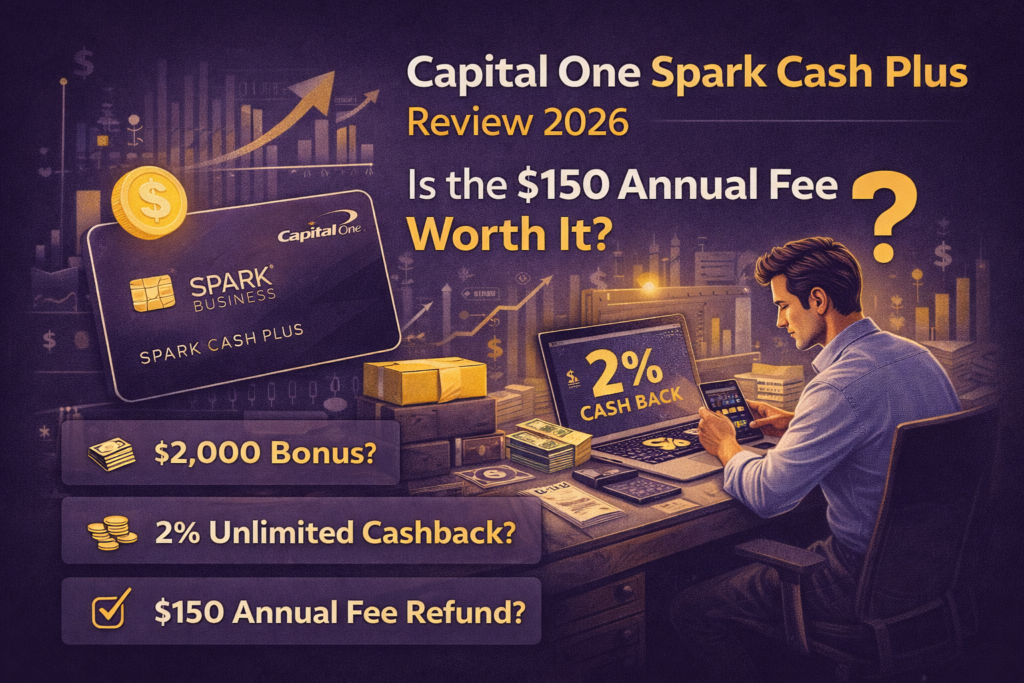
You see the $2,000 bonus. You see the unlimited 2% cash back. Then you see the $150 annual fee—and it’s not even waived the first year. Is this card a no-brainer for high spenders, or just an expensive way to look like you mean business? According to WalletHub and LendingTree, the Capital One Spark Cash Plus is considered the “best Capital One business card” and even a top overall business card—but only for companies spending more than $150,000 per year. [citation:1][citation:3]
This review breaks the card down using a simple formula:
The Spark Cash Plus is worth it if—and only if—your business meets three conditions:
- You can hit the bonus without forcing spend.
- Your annual spending justifies the fee.
- You can pay the balance in full every month.
Let’s test those three pillars.
Pillar 1: Is the Welcome Bonus Actually Realistic?
The numbers
- Base bonus: $2,000 cash back after spending $30,000 in the first 3 months. [citation:1][citation:3][citation:7]
- Additional bonus: $2,000 more for every $500,000 spent in the first year. [citation:1][citation:3][citation:7]
- Spark Cash (credit version): $1,000 bonus after $10,000 spend. [citation:3][citation:5]
Monthly spending required
- Base bonus:
$30,000 ÷ 3 months = $10,000 per month - Additional bonus:
$500,000 ÷ 12 months = $41,667 per month
That’s not a small-business side hustle level.
That’s real operating expense territory.
The critical question
Are you naturally spending $10,000 per month?
Or are you about to:
- Prepay vendors
- Buy unnecessary inventory
- Pull forward expenses
…just to chase a bonus?
If the answer is the second, the bonus loses its value immediately.
Pillar 2: Does the 2% Cashback Justify the Annual Fee?
Core earning structure
- 2% cash back on all purchases (unlimited). [citation:1][citation:3][citation:5]
- 5% cash back on hotels and rental cars through Capital One Travel. [citation:3][citation:5]
- Annual fee: $150 (not waived). [citation:3][citation:5]
The real comparison: 2% with fee vs 2% without fee
Competitors:
- Spark Cash Select: 1.5% with no fee
- Wells Fargo Signify Business: 2% with no fee
- Amex Blue Business Cash: 2% up to $50k/year, then 1% [citation:2][citation:3]
Break-even calculation
To justify a $150 annual fee:
You need $150 more in cashback than a no-fee card.
Formula:
$150 ÷ 0.02 = $7,500 annual spend
Result
If your business spends more than $7,500 per year,
the Spark Cash Plus already covers the annual fee from cashback alone.
And that’s before:
- The welcome bonus
- The annual fee refund
- The travel bonus
Conclusion of Pillar 2
The cashback structure alone justifies the annual fee for almost any real business.
The real issue isn’t the rewards.
It’s the card’s structure.
Pillar 3: Is the Annual Fee Refund a Real Benefit?
The official rule
- $150 annual fee is fully refunded if you spend $150,000 per year. [citation:3][citation:5][citation:7]
- Monthly equivalent: $12,500 per month. [citation:5][citation:7]
Capital One states:
“Spend $150,000 annually and we’ll refund the annual fee.” [citation:5][citation:7]
What that means in practice
If you spend $150k+ per year:
- Annual fee = $0
- Card becomes effectively free
If you spend less:
- You pay $150
- But you likely already earned that back
The real insight
The refund isn’t a gimmick.
It’s a signal.
This card is designed for companies with at least $150,000 in annual card spend.
The Elephant in the Room: This Is a Charge Card
The Spark Cash Plus is not a credit card.
It’s a charge card.
What that means
- No APR. You must pay the balance in full every month. [citation:1][citation:3][citation:5]
- If you don’t, there’s a 2.99% late fee on the balance. [citation:2][citation:3]
- No preset spending limit (NPSL). [citation:5][citation:7]
Advantages
- Flexible purchasing power
- Limit adjusts to business performance
- Ideal for high-spend, variable-expense companies
The fatal drawback
If your business ever needs to carry a balance,
this is the wrong card.
That 2.99% fee is effectively:
- More expensive than most APRs
- Charged as a penalty, not interest
Spark Cash Plus vs Spark Cash (Credit Version)
| Feature | Spark Cash Plus (Charge) | Spark Cash (Credit) |
|---|---|---|
| Card type | Charge (pay in full) | Credit (revolving) |
| Annual fee | $150 (refundable at $150k spend) | $0 first year, $95 after |
| Limit | No preset limit | Fixed credit line |
| APR | N/A | ~24.49% variable |
| Bonus | $2,000 ($30k in 3 months) | $1,000 ($10k in 3 months) |
| Ideal for | High-spend, full-pay businesses | Businesses needing credit flexibility |
Sources: Capital One, LendingTree, WalletHub. [citation:3][citation:4][citation:5]
Comparison: 2% No-Fee Competitors
| Card | Annual Fee | Cashback | Bonus | Cashback Limit | Key Advantage |
|---|---|---|---|---|---|
| Spark Cash Plus | $150 (refundable) | 2% unlimited | $2,000+ | Unlimited | Charge card, NPSL |
| Wells Fargo Signify | $0 | 2% unlimited | $500 | Unlimited | Traditional credit card |
| Amex Blue Business Cash | $0 | 2% up to $50k, then 1% | $250 | $50k/year | 0% intro APR |
Sources: Ramp, LendingTree. [citation:2][citation:3]
Comparison: Other Charge and Premium Cards
| Card | Annual Fee | Rewards | Bonus | Target User |
|---|---|---|---|---|
| Spark Cash Plus | $150 | 2% cashback | $2,000+ | High-spend businesses |
| Amex Plum Card | $250 | 1.5% or 2% early-pay discount | None | Cash-flow flexibility |
| Amex Business Platinum | $895 | 5x travel points | 200k points | Luxury business travel |
Source: WalletHub. [citation:6]
Analysis
- Plum Card offers early-pay discounts, but lower cashback.
- Business Platinum is a travel perks card, not a cashback tool.
- Spark Cash Plus delivers the highest flat-rate cashback among charge cards.
Who Should (and Shouldn’t) Get This Card
✅ You SHOULD get the Spark Cash Plus if:
- You spend $10,000+ per month consistently.
- You pay the balance in full every month.
- You want simple, unlimited cashback.
- You can hit $30,000 in three months.
- You value flexible spending power.
❌ You should NOT get it if:
- You ever carry balances.
- You spend under $50,000 annually.
- You forget payments.
- Your credit is only “good,” not excellent.
- You need a fixed credit line.
Only about 12% of applicants with “good” credit are approved. [citation:7]
The Final Math: Is the Fee Worth It?
Let’s run the numbers.
Scenario 1: $150,000 annual spend
- Annual fee: $0 (refunded)
- Cashback: $3,000
- Bonus: $2,000+
- Total value: $5,000+
Scenario 2: $50,000 annual spend
- Annual fee: $150
- Cashback: $1,000
- Bonus: $2,000 (if bonus achieved)
- Net value: $2,850
Still strong.
Scenario 3: $20,000 annual spend
- Annual fee: $150
- Cashback: $400
- Bonus: not achievable
- Net value: $250
Barely worth it.
Scenario 4: $10,000 annual spend
- Annual fee: $150
- Cashback: $200
- Bonus: not achievable
- Net value: $50
Not worth it.
Real break-even point
Once you factor in:
- Fee
- Bonus eligibility
- Cashback
The true break-even zone is around:
$40,000–$50,000 in annual spending.
Below that, a no-fee card is more rational.
Final Verdict
Yes, the Spark Cash Plus is worth it for high-spend businesses.
No, it’s not ideal for small or cash-tight companies.
This card isn’t about the fee.
It’s about the spending profile.
If you’re running $10k–$20k per month through cards and paying in full,
this is one of the strongest cashback tools available in 2026.
The Capital One Spark Cash Plus isn’t a card for everyone. It’s a card for businesses that have grown past the point of worrying about annual fees—because they know their spending volume makes the fee irrelevant.
At SmartCardTip.com, we don’t just tell you which card has the biggest bonus. We tell you which card actually makes sense for your numbers.
👉 Use our Business Card ROI Calculator to see exactly how much the Spark Cash Plus would put in YOUR pocket—based on your real monthly spend.
Word count: ~1,470 words.
This guide was updated for February 2026 by the SmartCardTip.com team. We analyze dozens of business credit card offers weekly so you know exactly which fees are justified—and which ones are just padding the issuer’s bottom line. Data compiled from Capital One, WalletHub, LendingTree, and Ramp as of Q1 2026