You’ve done everything right. You pay your bill on time, every time. You never carry debt. Yet last month, your credit score dropped 20 points for no reason you could see. You checked your report and everything looked fine. No late payments. No new accounts. So what happened?
The answer might be hiding in a number you’ve never paid attention to: your credit utilization ratio. And the good news? It’s one of the easiest factors in your score to fix once you understand how it works.
What Is Credit Utilization?
Credit utilization is the amount of credit you’re using compared to the total credit available to you. It’s a ratio, usually expressed as a percentage.
Here’s the basic formula:
(Total balances on all cards) ÷ (Total credit limits) × 100 = Utilization rate
Let’s look at a simple example.
Imagine you have two cards:
- Card A: $1,000 limit, $200 balance
- Card B: $500 limit, $0 balance
Your total debt:
- $200
Your total available credit:
- $1,500
Your utilization:
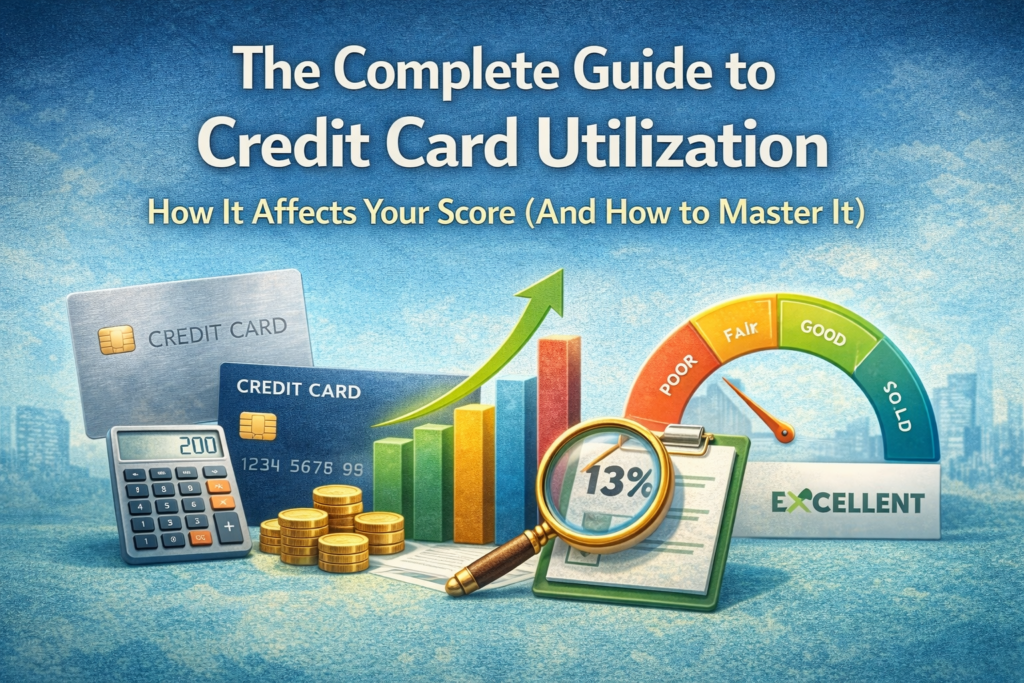
- $200 ÷ $1,500 = 13% utilization
That’s considered a healthy range.
Per-Card vs. Overall Utilization
FICO doesn’t look at just one number. It calculates utilization in two ways:
- Per-card utilization
- Each card is evaluated individually.
- Example: If one card is at 90% utilization, that hurts your score—even if your overall utilization is low.
- Overall utilization
- All balances divided by all limits.
- This is the number most people talk about.
Both numbers matter. A high balance on one card can damage your score even if your total utilization looks fine.
Why Utilization Matters So Much
Credit utilization makes up roughly 30% of your FICO score. That makes it the second most important factor, right behind payment history, which accounts for about 35%.
Together, these two factors control nearly two-thirds of your entire score.
From a lender’s perspective, utilization is a risk signal.
- High utilization suggests you may be overextended.
- It can indicate financial stress or reliance on credit.
- It increases the perceived risk of missed payments.
On the other hand:
- Low utilization shows you’re not dependent on credit.
- It signals strong financial control.
- It makes you look like a safer borrower.
Even if you pay your bill in full every month, a high reported balance can still cause your score to dip temporarily.
The 30% Rule: Myth or Truth?
You’ve probably heard the advice:
“Never use more than 30% of your available credit.”
This is good advice—but it’s not a magic number.
The Real Truth
The lower your utilization, the better for your score.
People with the highest credit scores—800 and above—often have utilization rates in the single digits:
- 7%
- 5%
- Even 1%
The Danger Zones
Here’s how utilization typically affects your score:
| Utilization Rate | Impact on Score |
|---|---|
| 0% | Neutral (but shows no activity) |
| 1–9% | Excellent |
| 10–29% | Good |
| 30–49% | Fair (starting to drop) |
| 50–74% | Poor (significant drop) |
| 75–100% | Severe (high risk) |
Above 30%, your score usually starts to decline.
Above 50%, the damage accelerates.
Above 75%, you’re firmly in the high-risk category.
So while 30% is a useful guideline, your real goal should be:
- Under 10% for optimal scores
- Under 30% at all times
The Big Secret: Utilization Has No Memory
Here’s the most empowering fact about credit utilization:
It has no memory.
Unlike late payments, which can stay on your report for up to seven years, utilization resets every single month.
Let’s say:
- Last month: 90% utilization
- Your score dropped significantly.
This month:
- You pay it down to 5%.
- The new balance gets reported.
Your score can rebound—often within 30 days.
There’s no long-term penalty for one bad utilization month. Once the balance drops and the new data is reported, the score usually follows.
That makes utilization one of the most flexible and fixable parts of your credit profile.
How to Calculate Your Ideal Utilization
If your goal is to optimize your score, aim for:
- Below 10% overall utilization
- Never above 30%
Here’s a practical example.
Let’s say you have:
- Total credit limits: $5,000
To stay under 10% utilization:
- 10% of $5,000 = $500
That means your total reported balances across all cards should stay under $500.
The Critical Detail: Statement Closing Date
Most people assume the number that matters is the balance on the due date. That’s not true.
What gets reported to the credit bureaus is usually the balance on your statement closing date, not your due date.
Example:
- Statement closes on the 10th.
- You have a $900 balance.
- You pay it off in full on the 20th (before the due date).
Even though you paid in full, the $900 balance was already reported. Your score reflects that high utilization.
Understanding this timing is crucial.
Practical Strategies to Lower Your Utilization
Here are proven tactics to manage your utilization effectively.
Strategy #1: The Early Payment Method
This is the simplest and most powerful technique.
Steps:
- Check your statement closing date.
- Pay down your balance before that date.
Example:
- Limit: $1,000
- You spend: $800
- Before closing date, you pay: $700
- Reported balance: $100
- Reported utilization: 10% instead of 80%
You still pay the full balance by the due date. You’re just adjusting the timing.
Strategy #2: Request a Credit Limit Increase
If your spending stays the same, a higher limit lowers your utilization automatically.
Example:
- Old limit: $1,000
- Balance: $200
- Utilization: 20%
New limit:
- $2,000
- Same balance: $200
- Utilization: 10%
Many issuers allow limit increase requests online, often using a soft inquiry that doesn’t impact your score.
Strategy #3: Distribute Spending Across Multiple Cards
If you have more than one card, avoid putting all your spending on a single one.
Example:
Instead of:
- One card at 80% utilization
- Other cards at 0%
Try:
- Several cards at 10–20% each
This keeps both:
- Per-card utilization low
- Overall utilization healthy
Strategy #4: Stop Using the Card Before the Closing Date
If your statement closes on the 15th:
- Stop using the card around the 10th or 12th.
- Let a small balance report.
- Resume normal spending after the statement closes.
This keeps reported utilization low without changing your overall spending habits.
What Not to Do: Common Mistakes
Avoid these traps that can accidentally increase your utilization.
❌ Mistake #1: Closing Old Cards
Closing a card removes its limit from your total available credit.
Example:
- Total limits: $10,000
- You close a $5,000 card
- New total limits: $5,000
If your balances stay the same, your utilization doubles instantly.
❌ Mistake #2: Reporting 0% Across All Cards
It sounds ideal, but a 0% utilization across every card can slightly hurt your score.
Why?
It shows no recent activity. The scoring model prefers to see some usage.
Better approach:
- Let a small charge report (1–5% utilization).
- Then pay it off.
❌ Mistake #3: Assuming Paying in Full Fixes Everything
Paying your balance in full is excellent for avoiding interest. But it doesn’t always protect your score.
If your statement closed with a high balance:
- That number was already reported.
- Your score reflects it, even if you pay in full later.
Timing matters as much as payment.
Frequently Asked Questions
Does checking my utilization lower my score?
No. Checking your balances or your own credit report doesn’t affect your score. Utilization is based on actual balances, not on how often you look at them.
How long does it take for utilization changes to affect my score?
Usually 30 to 45 days. Once the new balance is reported after the statement closes, the updated utilization is reflected in your score.
Should I keep a balance on my card to build credit?
Absolutely not. Carrying a balance only costs you money in interest. It does not improve your score. The best approach is to pay in full, while letting a small balance report before the statement date.
What if I can’t get below 30% right now?
Focus on paying down the balance over time. Even small improvements help.
- 70% utilization dropping to 50% is progress.
- 50% dropping to 30% is even better.
Once your utilization falls, your score can recover quickly.
Conclusion
Credit utilization is the silent architect of your credit score. Unlike payment history, where one mistake can echo for years, utilization gives you a fresh start every single month.
Learn to manage it, and you take control of nearly one-third of your score. Master it, and you’ll never be surprised by a random 20-point drop again.
Your score is a tool. Utilization is one of its sharpest edges—use it wisely.
This guide was updated for 2026 by the SmartCardTip.com team. We believe that understanding the mechanics of your credit score is the first step to mastering it.