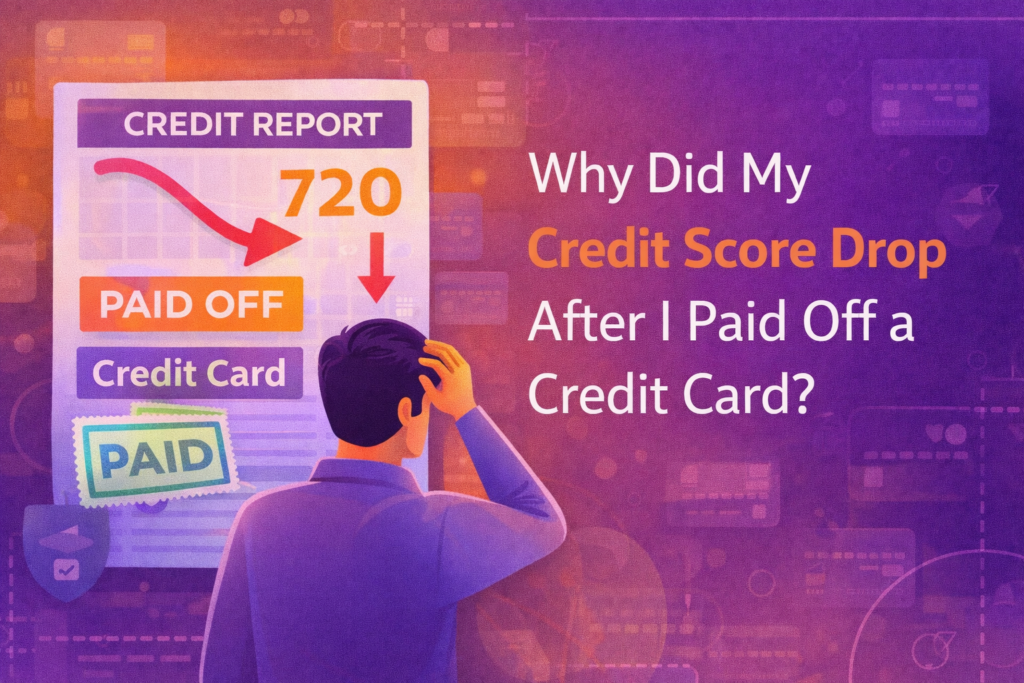
Paying off a credit card feels like a financial win. You reduce your debt, free up cash flow, and assume your credit score should go up. But many people check their score a few weeks later and see the opposite: it dropped.
That can be frustrating—especially when you did exactly what financial advice tells you to do.
The good news is that this kind of drop is usually temporary and explainable. In most cases, it has nothing to do with you doing something wrong. It’s about how credit scoring models interpret changes in your profile.
Let’s break down the three most common reasons your credit score might drop after paying off a credit card—and what to do next.
The “Paid Off” Paradox: Why Scores Don’t Always Move the Way You Expect
Credit scores are not moral judgments. They’re statistical models built to predict risk.
When you pay off a credit card, several parts of your credit profile may change at the same time:
- Your utilization ratio
- Your account balances
- Your account activity
- Your credit mix
- The timing of reported data
Even if your financial situation improved, the scoring model may interpret those changes in ways that cause a temporary drop.
This effect is more common today because credit card balances and interest rates remain historically high. By late 2025, total U.S. credit card debt reached around $1.3 trillion, showing how widespread revolving balances have become.
At the same time, average credit card interest rates were hovering around 21% to 22%, depending on the dataset.
That environment makes utilization and timing even more sensitive in scoring models.
Reason #1: Reporting Timing and Statement Snapshots
One of the most common explanations is simple: the score drop isn’t caused by the payoff itself.
How credit reporting actually works
Credit card companies usually report your balance to the credit bureaus:
- Once per billing cycle
- On or around the statement closing date
That means:
- You might pay off the card today
- But the credit report still shows the old balance
- Or it shows a different account update at the same time
If another card reported a higher balance that month, your overall utilization could have increased—causing a score drop.
Example
Let’s say you have:
- Card A: $2,000 limit, $1,000 balance
- Card B: $2,000 limit, $0 balance
Total utilization:
$1,000 ÷ $4,000 = 25%
You pay off Card A completely. But before the update hits your report:
- Card B reports a $1,200 balance
Now your report shows:
- Card A: $0
- Card B: $1,200
Total utilization:
$1,200 ÷ $4,000 = 30%
Even though you paid off a card, your reported utilization increased—and your score may drop slightly.
Reason #2: Zeroing Out a Card Changes Utilization Distribution
Most people focus on overall utilization. But credit scoring models also look at:
- Utilization per card
- Number of cards with balances
When you pay off a card, you may accidentally create a less favorable distribution.
What scoring models tend to prefer
In many cases, scores are slightly higher when:
- One card reports a small balance
- Other cards report zero
This is sometimes called the “all-zero except one” effect.
Why paying off a card can lower your score
Imagine you had:
- Card A: $1,000 balance
- Card B: $500 balance
- Card C: $0 balance
Then you pay off Card B completely.
Now:
- Card A: $1,000 balance
- Card B: $0
- Card C: $0
Your total debt is lower, but:
- One card is carrying all the balance
- That card’s utilization may be higher
If Card A has a $2,000 limit, it’s now at 50% utilization, which can hurt your score more than two cards at moderate levels.
Reason #3: Other Accounts Updated at the Same Time
Credit scores are calculated based on your entire credit profile, not just one account.
When you paid off a credit card, other things may have happened around the same time:
- Another card reported a higher balance
- A loan balance updated
- A hard inquiry appeared
- An old account aged past a threshold
Any of these can affect your score independently.
Why this happens more often now
Credit behavior has become more volatile in recent years. According to Federal Reserve data, delinquency rates and financial stress indicators have been rising in certain segments of the population, especially where cost-of-living pressures are higher.
Even though overall credit card delinquency rates at major banks were around 3% in 2025, shifts in balances and payment patterns are still enough to move scores month to month.
That’s why a score drop after a payoff is often just a coincidence with other changes.
A Less Common Reason: Closing the Card After Paying It Off
Some people pay off a card and then close it immediately. That can hurt your score for two reasons:
1. Lower total available credit
If you close a card, you lose its credit limit.
Example:
Before closing:
- Total limits: $10,000
- Balances: $2,000
- Utilization: 20%
After closing a $4,000-limit card:
- Total limits: $6,000
- Balances: $2,000
- Utilization: 33%
Your score may drop because your utilization just increased.
2. Shorter average account age (over time)
Older accounts help your score. Closing one can:
- Reduce your average account age
- Make your profile look less established
How Big Is the Score Drop Usually?
In most cases, the drop is:
- Small: 5 to 20 points
- Temporary: often recovers in 1–3 months
Large drops usually happen only when:
- Utilization jumps significantly
- Multiple accounts change at once
- A late payment or inquiry is involved
What to Do Next: A Simple 30-Day Recovery Plan
If your score dropped after paying off a card, here’s what to do.
Week 1: Check your credit reports
Look for:
- Updated balances
- New inquiries
- Any errors
Make sure the paid-off card is reporting correctly.
Week 2: Adjust utilization
Aim for:
- Under 30% overall utilization
- Ideally under 10% for faster score improvement
You can do this by:
- Making a mid-cycle payment
- Spreading balances across cards
- Paying before the statement closing date
Week 3: Set autopay
Make sure:
- At least the minimum payment is automatic
- You never miss a due date
Payment history remains the most important scoring factor.
Week 4: Let the system update
Credit scores respond to:
- New statement data
- Updated balances
- Consistent behavior
In many cases, the score will rebound once the next cycle reports.
Realistic Timeline for Score Recovery
If the drop was caused by utilization or timing:
- 30 days: first improvements
- 60–90 days: score often returns to prior range
- 6 months: stable upward trend with on-time payments
Consistency matters more than one payoff event.
Common Mistakes After Paying Off a Card
Avoid these:
Closing the account immediately
Keep it open unless:
- It has a high annual fee
- You truly don’t need it
Running up another card right away
This can:
- Cancel out the benefit of the payoff
- Increase your utilization again
Applying for multiple new cards
Each application:
- Adds a hard inquiry
- Can temporarily lower your score
When a Score Drop Is Actually a Warning Sign
Sometimes, the drop isn’t about the payoff at all. It could signal:
- A late payment on another account
- A collection account
- A new inquiry
- A large balance increase elsewhere
If the drop is more than 30–40 points, review your reports carefully.
The Bottom Line
If your credit score dropped after paying off a credit card, it usually comes down to one of three reasons:
- Reporting timing and statement snapshots
- Changes in utilization distribution
- Other accounts updating at the same time
In most cases, the drop is small and temporary. With:
- Low balances
- On-time payments
- Stable account activity
Your score typically recovers within a few months.
Paying off debt is still one of the best long-term moves for your financial health—especially in a market where average credit card interest rates remain around 20% or higher.
The key is understanding how credit scoring works so short-term score fluctuations don’t distract you from long-term progress.