If you’ve ever looked at your credit card and seen two different dates—the statement closing date and the payment due date—you’re not alone in feeling confused.
Many cardholders ask the same question:
Should I pay my credit card before the statement closes, or just before the due date?
The answer depends on your goal.
If you want to avoid interest, one date matters more.
If you want to improve your credit score, another date becomes important.
Understanding the difference can help you save money and boost your score at the same time.
The Two Dates That Matter Most
Every credit card has two key dates in each billing cycle.
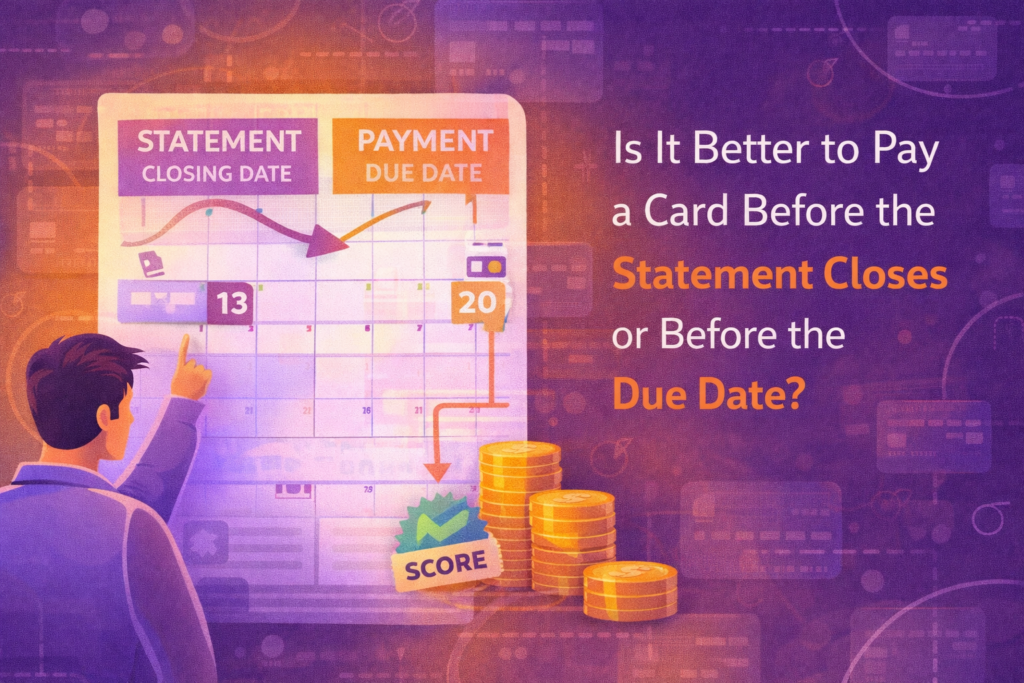
1. Statement closing date
This is the day your billing cycle ends. On this date:
- Your statement balance is calculated
- That balance is typically reported to the credit bureaus
- A new billing cycle begins
Think of it as a snapshot of your account.
2. Payment due date
This is the deadline to pay at least the minimum amount.
If you pay the statement balance by this date:
- You usually avoid interest
- Your account stays in good standing
Most cards give you about 21 to 25 days between the statement closing date and the due date.
Why These Dates Affect Your Credit Score
Your credit score is influenced heavily by credit utilization. This is the percentage of your available credit that you’re using.
Example:
- Credit limit: $2,000
- Reported balance: $1,000
- Utilization: 50%
Higher utilization generally lowers your score.
What most people don’t realize
Credit bureaus usually see the balance that appears on your statement closing date, not your real-time balance.
So even if:
- You pay the card off a few days later
- Before the due date
Your credit report may still show a high balance for that month.
Paying Before the Statement Closes: The Credit Score Strategy
If your goal is to improve your credit score, paying before the statement closes is often the better move.
Why it works
When you pay down your balance before the closing date:
- The reported balance is lower
- Your utilization drops
- Your score may increase
Example
Let’s say:
- Limit: $3,000
- Balance before closing date: $1,500 (50% utilization)
If you pay $1,200 before the statement closes:
- New balance: $300
- Reported utilization: 10%
That single change can improve your score.
Paying Before the Due Date: The Interest Strategy
If your goal is to avoid interest, the due date is what matters most.
As long as you:
- Pay the full statement balance
- Before the due date
You usually keep your grace period.
That means:
- No interest on purchases
- No penalties
- Account stays current
The Real Cost of Waiting Until the Due Date
Many people carry balances because interest rates are high.
In 2025, the average credit card interest rate was around 21% to 22%, according to Experian. That’s near historic highs.
At the same time, total U.S. credit card debt reached over $1.3 trillion, showing how common revolving balances have become.
With rates this high, even small balances can become expensive if you don’t pay them off quickly.
Best Strategy for Each Goal
Here’s the simplest way to decide.
Goal: Avoid interest
Do this:
- Pay the full statement balance
- Before the due date
This keeps your account interest-free (for purchases).
Goal: Improve your credit score
Do this:
- Pay most of the balance before the statement closing date
- Leave a small balance to report (under 10% of your limit)
- Pay the rest before the due date
This shows:
- Low utilization
- Active account
- On-time payments
The “Two-Payment” Method (Simple and Effective)
Many experienced card users follow this approach.
Step 1: Mid-cycle payment
A few days before the statement closes:
- Pay down most of your balance
- Aim for under 10–30% utilization
Step 2: Final payment
Before the due date:
- Pay the remaining statement balance
- Avoid interest completely
This method helps both:
- Your credit score
- Your finances
What Changes If You Carried a Balance Last Month
If you didn’t pay your statement balance in full last cycle:
- You may lose your grace period
- Interest can start immediately on new purchases
In that case:
- Paying earlier helps reduce interest
- But you may still see some residual interest on the next statement
A Simple Monthly Calendar You Can Follow
Here’s an easy example.
Example cycle
- Statement closes: 15th of the month
- Payment due: 10th of the next month
Ideal payment schedule
Day 10:
Make a mid-cycle payment to reduce balance.
Day 13 or 14:
Check balance and pay it down further if needed.
Day 15:
Statement closes with a low balance reported.
Before the 10th:
Pay the full statement balance.
Result:
- Low utilization reported
- No interest charged
- Positive payment history
Common Mistakes People Make
Only paying on the due date
This can:
- Avoid interest
- But still report high utilization
Your score may drop temporarily.
Letting cards report high balances every month
Even if you pay in full later, high reported balances can:
- Lower your score
- Hurt loan or card approvals
Closing cards after paying them off
This reduces:
- Total available credit
- Average account age
Both can negatively affect your score.
Does Paying Early Hurt Your Credit?
No. Paying early never hurts your score.
In fact, it usually helps by:
- Lowering utilization
- Reducing debt
- Showing responsible behavior
The only exception is when:
- All cards report zero balances
- And your score model prefers one small balance
But the impact is usually small.
What’s the Ideal Utilization Level?
Most experts recommend:
- Under 30% for general credit health
- Under 10% for best scoring results
Example:
If your limit is $5,000:
- Under 30% = below $1,500
- Under 10% = below $500
Quick Decision Guide
If you’re not sure what to do, follow this:
Just want to avoid interest?
→ Pay the statement balance before the due date.
Trying to raise your credit score?
→ Pay most of the balance before the statement closes.
Want both?
→ Use the two-payment method.
The Bottom Line
So, is it better to pay your card before the statement closes or before the due date?
- To avoid interest: the due date matters most
- To improve your credit score: the closing date matters more
The best approach for most people is simple:
- Pay down the balance before the statement closes.
- Pay the rest before the due date.
This keeps your interest at zero and your credit score in better shape over time.
With interest rates still hovering above 20% on average and total card debt at record levels, managing payment timing isn’t just about your score—it can save you real money every month.