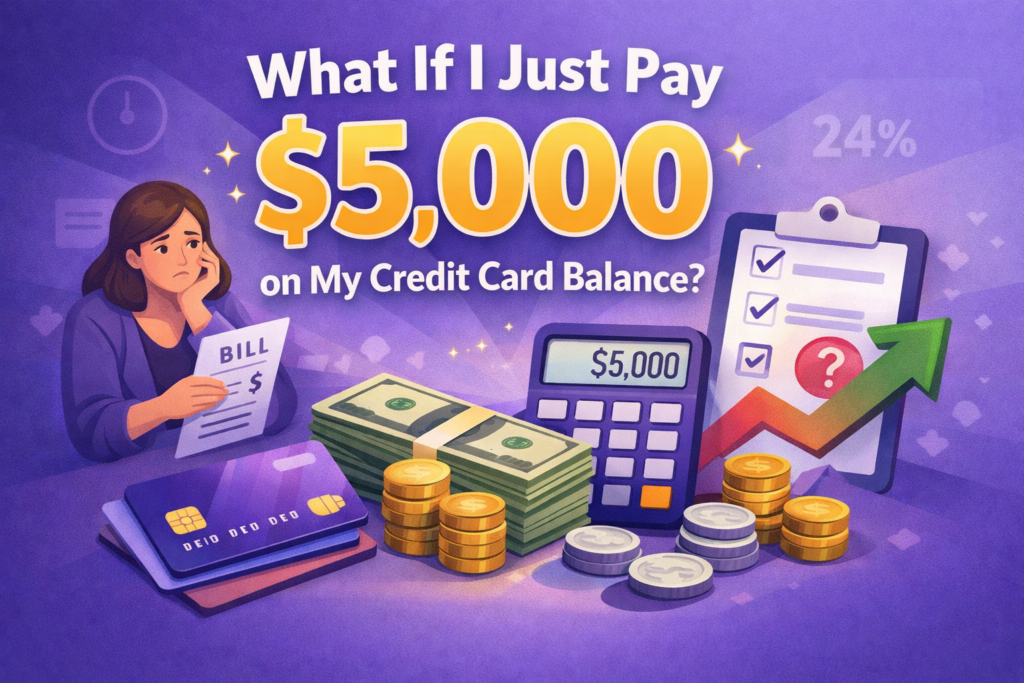
You look at your statement and see a $5,000 balance. The minimum payment says $145. That doesn’t look too bad. You think, “I can handle that for a while.”
And technically, you can. That’s exactly how credit cards are designed.
But what most people don’t realize is how long that “for a while” actually becomes — and how much interest builds up along the way.
In 2026, this question matters more than ever. According to the Federal Reserve and New York Fed household debt reports, total U.S. credit card balances crossed $1.2 trillion, and average credit card APRs have stayed above 20%, with many accounts closer to 25% or more. High interest means minimum payments stretch balances out for years.
Let’s walk through what really happens when you carry a $5,000 balance and only pay the minimum.
What “Minimum Payment” Actually Means
Most credit card minimum payments are calculated using one of these formulas:
Common structure:
- 1% of the balance
plus - Interest
plus - Any fees
Or:
- 2%–3% of the total balance
This means the minimum payment shrinks over time as your balance drops. It also means that most of what you pay at the beginning goes toward interest — not the balance itself.
That’s why minimum payments feel manageable… but take much longer than expected.
The Reality: $5,000 Balance, Minimum Payments Only
Let’s look at a realistic scenario in 2026.
Assumptions:
- Balance: $5,000
- APR: 24% (common for many accounts today)
- Minimum payment: 2% of balance
- No new purchases
What happens over time
| Time | Balance Remaining | Total Paid So Far |
|---|---|---|
| Year 1 | ~$4,300 | ~$1,350 |
| Year 3 | ~$3,100 | ~$3,600 |
| Year 5 | ~$2,200 | ~$5,700 |
| Year 10 | ~$900 | ~$9,000 |
| Year 15+ | $0 | ~$11,000–$12,000 total |
Result:
- Time to payoff: about 15–17 years
- Total paid: more than $11,000
- Interest alone: about $6,000
So the $5,000 purchase ends up costing more than double.
And this assumes:
- No late payments
- No additional purchases
- No penalty APR
- No fees
In real life, many balances last even longer.
Why It Takes So Long
There are three main reasons minimum payments stretch balances out.
1) Most of your payment goes to interest at the beginning
With a 24% APR, your monthly interest rate is about 2%.
On a $5,000 balance:
- Monthly interest = about $100
If your minimum payment is $145:
- $100 goes to interest
- Only $45 goes toward the balance
That’s why the balance barely moves at first.
2) The minimum payment gets smaller every month
Because the minimum is based on your balance, it shrinks as you pay down the card.
Example:
- Balance drops to $4,000
- Minimum might drop from $145 to around $115
This slows your payoff even more.
3) High APRs in 2026 make interest heavier
According to the CFPB’s credit card market data, the average APR on general-purpose credit cards reached about 25% in recent reports, with new accounts often even higher.
That means balances today grow faster than they did a decade ago.
How APR Changes the Timeline
Let’s compare three interest rate scenarios for the same $5,000 balance with minimum payments.
| APR | Payoff Time | Total Paid |
|---|---|---|
| 18% | ~12 years | ~$8,700 |
| 24% | ~16 years | ~$11,500 |
| 29% | 18+ years | ~$14,000+ |
A difference of 10 percentage points in APR can add several years and thousands of dollars in interest.
What Happens If You Pay Just a Little More
Now let’s see how small changes affect the timeline.
Scenario A: Minimum payments only
- Time: ~16 years
- Total paid: ~$11,500
Scenario B: Fixed $200 per month
- Time: about 3 years
- Total paid: ~$7,100
- Interest saved: ~$4,400
Scenario C: Fixed $300 per month
- Time: about 20 months
- Total paid: ~$6,100
- Interest saved: ~$5,400
Even modest increases dramatically shorten the payoff.
Why So Many People Stay on Minimum Payments
There are a few reasons this trap is common.
1) Minimum payments feel affordable
A $145 payment feels manageable compared to a $300 or $400 plan.
2) The timeline isn’t obvious
Many people don’t realize the payoff stretches into decades.
3) Rising living costs
With inflation and higher interest rates, more households rely on credit cards to bridge gaps.
The New York Fed has reported rising delinquency rates in certain credit card segments, showing how payment stress has increased in recent years.
The Hidden Risk: What Happens If You Keep Using the Card
All the timelines above assume no new purchases.
If you continue to use the card while making minimum payments:
- The balance may never go down
- Interest compounds indefinitely
- You could stay in debt for decades
This is how many people end up with long-term revolving balances.
A Simple Plan to Escape the Minimum Payment Cycle
If you’re carrying a $5,000 balance, you don’t need a complex strategy. You just need a clear, realistic plan.
Step 1: Stop adding to the balance
Use debit or cash for new purchases while you’re paying it down.
Step 2: Pick a fixed monthly payment
Instead of the minimum, choose a fixed number:
- $200/month = about 3 years
- $250/month = about 2.5 years
- $300/month = under 2 years
Consistency matters more than perfection.
Step 3: Automate the payment
Set autopay for your fixed amount. This prevents late fees and keeps progress steady.
If You Can’t Afford More Than the Minimum
If your budget is tight, focus on small improvements.
Try one of these:
- Add $25 extra per month
- Use tax refunds or bonuses toward the balance
- Make a second small payment mid-cycle
Even small increases shorten the payoff timeline.
For example:
- Minimum only: ~16 years
- Minimum + $25: ~10–11 years
That’s years of interest avoided.
The Psychological Shift That Helps
Instead of thinking:
“What’s the minimum I have to pay?”
Try thinking:
“What’s the fastest realistic payment I can sustain every month?”
This shift turns the card from a long-term burden into a short-term project.
The Bottom Line
If you carry a $5,000 credit card balance and only make minimum payments:
- You could stay in debt for 15–18 years
- You may pay over $11,000 total
- More than half of that could be interest
But small changes make a huge difference.
- $200/month: about 3 years
- $300/month: under 2 years
The minimum payment is designed to keep the account current — not to get you out of debt quickly.
If you want to shorten the timeline, the key is simple: pick a fixed amount, automate it, and stick with it.
Try the payoff calculator:
Credit Card Payoff Calculator
Amortization schedule (first 24 months)
| Month | Payment | Interest | Principal | Balance |
|---|