Many people believe that as long as they pay their credit card on time, their credit score will stay healthy. That’s only partly true.
Payment history is the biggest factor in most credit scoring models, but it’s not the only one. Your credit card balance—specifically your credit utilization—can lower your score even if you never miss a payment.
So the real question becomes:
At what balance does your credit card start hurting your credit score?
The answer isn’t a single number. It’s a set of utilization ranges that scoring models tend to treat differently.
Utilization Explained in One Minute
Credit utilization is the percentage of your available credit that you’re using.
Example:
- Credit limit: $2,000
- Current balance: $1,000
- Utilization: 50%
This ratio is calculated:
- Per card
- Across all your cards combined
Both numbers matter to your credit score.
Utilization is one of the most important scoring factors after payment history. That’s because high balances suggest a higher risk of default, even if you’re paying on time.
Why Utilization Matters More Than Ever
Credit card debt in the United States has been rising steadily. By late 2025, total credit card balances reached around $1.3 trillion, one of the highest levels on record.
At the same time, the average credit card interest rate was hovering around 21% to 22% in 2025, depending on the source.
That combination—high balances and high interest—means lenders pay close attention to how much of your available credit you’re using.
The “Threshold” Myth: It’s Not Just One Number
You may have heard the rule:
“Keep your utilization under 30%.”
That’s a good general guideline, but credit scoring models actually behave more like a sliding scale.
Here’s how utilization levels typically affect scores.
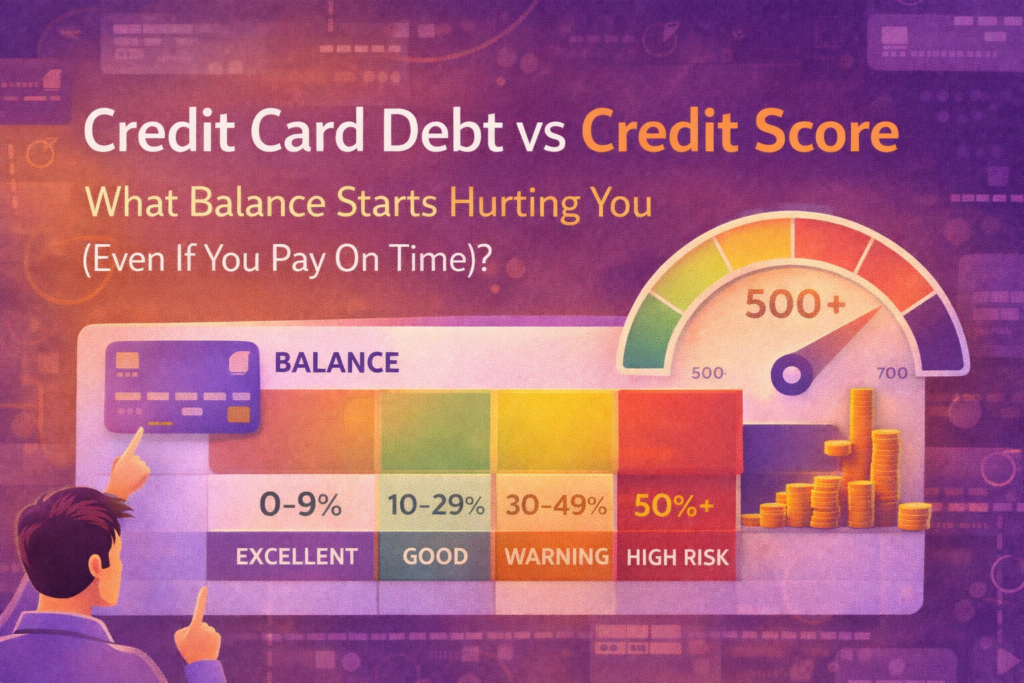
0–9% utilization: Excellent range
This is where many of the highest scores live.
In this range:
- You’re using credit
- But not relying on it heavily
- Risk appears low to lenders
Many top-tier credit profiles report utilization below 10%.
10–29% utilization: Good range
This is still considered healthy.
In this range:
- Scores are usually stable
- Most approvals remain strong
- Interest rates offered are often competitive
This is the “safe zone” for everyday use.
30–49% utilization: Warning range
This is where scores often begin to drop.
In this range:
- Lenders see higher reliance on credit
- Risk perception increases
- Scores may fall noticeably
You may still qualify for credit, but not always at the best terms.
50%+ utilization: High-risk range
Once you cross the halfway mark, scoring models often react more strongly.
In this range:
- Score drops can be significant
- Approval odds decrease
- Interest rates may increase
Even with perfect payment history, this level of utilization signals risk.
Per-Card vs Overall Utilization: The Detail Most People Miss
Many people focus only on overall utilization, but credit scoring models also look at:
- Utilization on each individual card
- Number of cards carrying balances
Example
Let’s say you have two cards:
Card A
- Limit: $5,000
- Balance: $4,000 (80%)
Card B
- Limit: $5,000
- Balance: $0 (0%)
Overall utilization:
- $4,000 ÷ $10,000 = 40%
Even though your overall utilization is 40%, Card A is at 80%, which is considered very high.
That single high-utilization card can drag your score down more than you’d expect.
Why Your Score Can Drop Even If You Pay on Time
Here’s a common situation:
- You charge $2,000 on a $3,000-limit card
- You pay the full balance before the due date
- But the statement closes with the $2,000 balance
Your credit report shows:
- $2,000 balance
- $3,000 limit
- 67% utilization
Even though you paid on time, the score model sees a high balance and adjusts your score accordingly.
How Much Can High Utilization Lower Your Score?
The exact drop depends on:
- Your starting score
- Number of accounts
- Credit history length
- Other balances
But typical patterns look like this:
From 10% to 30% utilization
Possible drop:
- 5 to 20 points
From 30% to 50% utilization
Possible drop:
- 20 to 40 points
From 50% to 80% utilization
Possible drop:
- 40 to 100+ points
These changes can happen even if you’ve never missed a payment.
The “Invisible” Balance Problem
One reason people get surprised by score drops is timing.
Credit card issuers usually report balances:
- On the statement closing date
- Not on the due date
So if you:
- Carry a high balance during the cycle
- Pay it off right before the due date
Your report may still show a high utilization for that month.
How to Lower Reported Utilization Without Changing Your Spending
You don’t always have to spend less. Sometimes, you just need to adjust when you pay.
Strategy 1: Pay before the statement closes
A few days before the closing date:
- Make a payment
- Reduce the balance that gets reported
This lowers your utilization instantly.
Strategy 2: Split your payments
Instead of paying once a month:
- Pay part of the balance mid-cycle
- Pay the rest before the due date
This keeps your reported balance lower.
Strategy 3: Request a credit limit increase
If your income and credit history support it:
- A higher limit reduces utilization
- Even if your spending stays the same
Example:
Before:
- Limit: $2,000
- Balance: $1,000
- Utilization: 50%
After increase to $4,000:
- Balance: $1,000
- Utilization: 25%
Your score may improve without changing spending.
A Real-World Example Using Today’s Interest Rates
Let’s say:
- Balance: $3,000
- APR: 22% (close to current averages)
- Minimum payment: 2% of balance
If you only make minimum payments:
- It could take years to pay off
- You may pay thousands in interest
- Your utilization stays high
- Your score stays suppressed
But if you reduce the balance to:
- $600 on a $3,000 limit (20% utilization)
You:
- Improve your score
- Reduce interest costs
- Improve approval odds
Ideal Utilization Targets
Here’s a simple guide.
For everyday credit health
Keep utilization:
- Under 30%
For the best possible scores
Aim for:
- Under 10%
Many high-score profiles stay in the 1–9% range.
What Happens When You Pay Down Balances
The good news about utilization is:
- It has no long-term memory
- It resets each billing cycle
If you:
- Pay down balances
- Let lower balances report
Your score can improve within:
- 30 to 60 days
This is one of the fastest ways to raise a credit score.
Common Utilization Mistakes
Maxing out one card
Even if others are empty, one maxed-out card hurts your score.
Only paying on the due date
You avoid interest, but still report high balances.
Closing cards after paying them off
This reduces your total credit limit and raises utilization.
Quick Utilization Rule of Thumb
If you want a simple rule:
- Under 30%: acceptable
- Under 20%: good
- Under 10%: excellent
- Over 50%: likely hurting your score
The Bottom Line
Your credit card balance can start hurting your credit score well before you miss a payment.
Typical impact ranges:
- Under 10%: best for scores
- 10–29%: healthy range
- 30–49%: noticeable score drops
- 50%+: major impact possible
Even if you always pay on time, high utilization can:
- Lower your score
- Reduce approval chances
- Increase borrowing costs
The good news is that utilization is one of the easiest factors to fix. By paying down balances or adjusting payment timing, you can often see score improvements within a single billing cycle.