The Hidden Cost of Everyday Credit Card Use
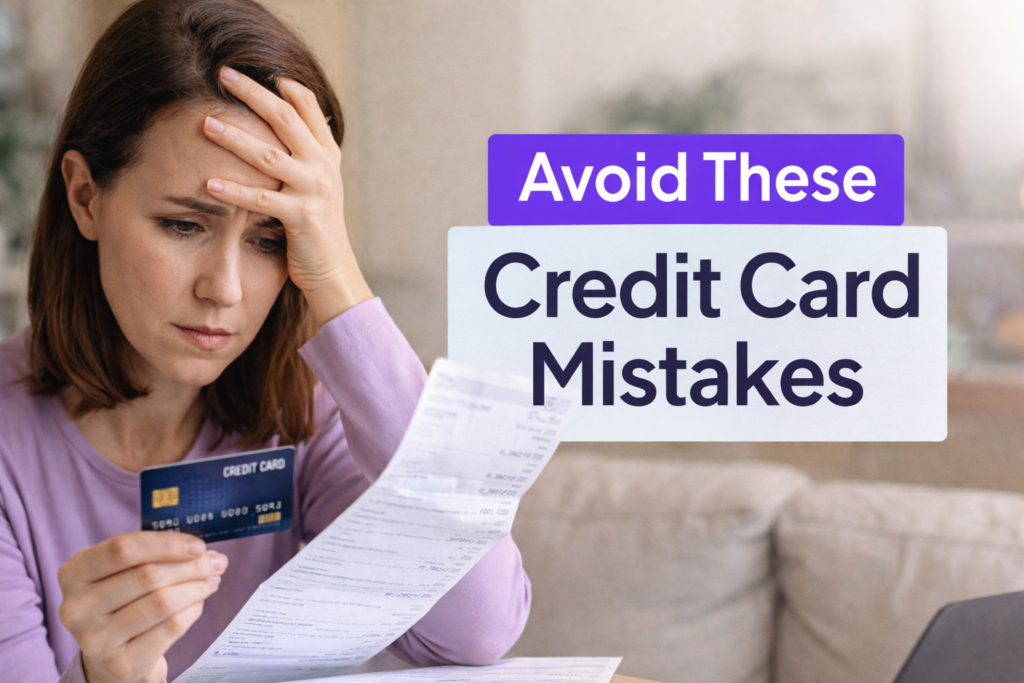
Credit cards are designed to be convenient. They offer rewards, purchase protection, and flexible payment options. But for millions of Americans, small credit card habits quietly turn into expensive long-term costs.
According to data from the Federal Reserve, the average credit card APR exceeded 21% in 2025–2026 — one of the highest levels in decades. That means even modest balances can generate hundreds of dollars in annual interest.
The problem isn’t usually reckless spending. It’s small, common behaviors: paying only the minimum, carrying balances unnecessarily, or missing optimization opportunities.
This guide explains the most expensive credit card mistakes in 2026, how they cost the average user over $1,200 per year, and exactly how to fix them with simple, practical strategies.
If you want to reduce interest, improve your credit score, and keep more of your money, these are the mistakes to eliminate first.
Section 1 — Paying Interest When You Don’t Have To
The single most expensive credit card mistake is carrying a balance unnecessarily.
When you carry a balance, interest compounds daily. Even small balances grow quickly at today’s rates.
Real example: $4,000 balance at 21% APR
- Monthly interest rate: ~1.75%
- Monthly interest cost: $70
- Annual interest cost: $840
That’s $840 lost without buying anything new.
Many people assume carrying a balance helps their credit score. It doesn’t.
Credit scores benefit from usage — not from paying interest.
Paying your full statement balance each month completely avoids interest while still building credit history.
Use the calculator below to estimate your monthly and yearly interest cost
Credit Card Interest Cost Calculator
Estimate how much interest you’re paying — and how long payoff may take.
Estimates assume your APR and payment stay constant and you don’t add new charges. This is educational, not financial advice.
If your payment doesn’t cover interest, that’s a red flag — increase the payment or consider a 0% APR strategy.
If you’re carrying a balance, see our step-by-step plan in Credit Building Guide.
Want to maximize rewards without debt? Start here: Cash Back Cards.
Section 2 — Paying Only the Minimum Payment
Minimum payments are designed to maximize interest paid over time.
Most minimum payments are calculated as:
- 1%–3% of balance
- Plus interest and fees
This creates extremely slow repayment timelines.
Example: $5,000 balance at 21% APR
| Payment Strategy | Monthly Payment | Total Interest | Time to Pay Off |
|---|---|---|---|
| Minimum payment | ~$125 | ~$3,200 | 16+ years |
| Fixed payment | $300 | ~$900 | 20 months |
Minimum payments can triple the true cost of purchases.
The minimum protects your credit score from late payments — but it does not protect your finances.
Paying more than the minimum dramatically reduces total interest.
Section 3 — Letting Your Utilization Ratio Stay Too High
Your credit utilization ratio measures how much of your available credit you’re using.
It accounts for approximately 30% of your FICO score.
High utilization hurts your score and increases financial risk.
Example: $2,000 balance on $2,500 limit
Utilization: 80%
Recommended utilization: below 30%
High utilization signals elevated risk to lenders.
It can result in:
- Lower credit scores
- Higher interest rates on new accounts
- Reduced approval odds
Even if you pay on time, high utilization damages your credit profile.
Lower utilization improves your score quickly.
You can learn more in our Credit Building Guide.
Section 4 — Missing Due Dates and Paying Late Fees
Late fees are one of the most avoidable credit card costs.
As of 2026, typical late fees reach up to $41 per missed payment.
But the fee itself is only part of the problem.
Late payments can also trigger:
- Penalty APR increases (up to 29.99%)
- Credit score damage
- Loss of promotional APR offers
Real example: One late payment impact
- Late fee: $41
- Penalty APR increase impact: $300+ annually
- Credit score drop: 60–100 points possible
A single late payment can cost hundreds of dollars over time.
Setting automatic payments prevents this entirely.
Section 5 — Ignoring Promotional 0% APR Opportunities
Many cards offer 0% APR periods on purchases or balance transfers.
These periods typically last 12–18 months.
Failing to use them strategically can cost hundreds or thousands in interest.
Example: $3,000 purchase
At 21% APR:
- Interest cost over 18 months: ~$570
At 0% APR:
- Interest cost: $0
Same purchase. Massive difference in cost.
These offers are especially useful for large purchases or debt repayment strategies.
Learn more in our guide to Cash Back Cards and promotional offers.
Section 6 — Real Data: What Americans Actually Pay in Credit Card Interest
Credit card costs have increased significantly due to rising interest rates.
According to the Federal Reserve, average credit card APR exceeded 21% in 2025–2026, the highest recorded level in modern consumer credit history.
Source:
Federal Reserve Consumer Credit Report
https://www.federalreserve.gov/releases/g19/current/
Additional key data:
- Average revolving balance: ~$6,500 (Experian)
- Average annual interest paid: $1,000–$1,400 for revolving users
- Over 60% of cardholders carry balances at least occasionally
These numbers confirm that credit card interest is one of the most expensive routine financial costs.
But most of it is avoidable.
Section 7 — Comparison: Cost of Smart vs Poor Credit Card Usage
| Strategy | Balance | APR | Interest Paid (12 Months) | Outcome |
|---|---|---|---|---|
| Pay full balance monthly | $3,000 | 21% | $0 | Optimal |
| Carry balance full year | $3,000 | 21% | ~$630 | Expensive |
| Use 0% APR promotion | $3,000 | 0% | $0 | Strategic |
| Minimum payments only | $3,000 | 21% | ~$1,200 over time | Worst case |
The difference between optimized and unoptimized usage is dramatic.
Section 8 — How to Fix These Mistakes: Step-by-Step Plan
Here’s a simple system to eliminate unnecessary credit card costs.
Step 1 — Always Pay Statement Balance in Full
This eliminates interest entirely.
Interest only applies when balances carry past the due date.
Step 2 — Keep Utilization Below 30%
Example:
Limit: $2,000
Maximum balance target: $600
This improves credit score and approval odds.
Step 3 — Set Automatic Payments
Enable autopay for at least the statement balance.
This prevents:
- Late fees
- Credit score damage
- Penalty APR
Step 4 — Use Promotional APR Strategically
Only use promotional APR if you have a repayment plan.
Example:
$2,400 purchase
18 months 0% APR
Monthly payment needed: $133
No interest paid.
Common mistakes to avoid:
- Paying only minimum payment
- Missing payment dates
- Maxing out credit limits
- Ignoring promotional offers
- Carrying balances unnecessarily
Expert Tip
Most experienced credit users treat credit cards like debit cards.
They never carry balances.
They only use cards for convenience, rewards, and credit building.
This approach eliminates interest entirely.
Conclusion: Small Credit Card Habits Have Massive Financial Impact
Credit cards themselves are not expensive.
Interest is expensive.
The difference between optimized and unoptimized usage often exceeds $1,200 per year.
Avoiding the five mistakes covered in this guide can help you:
- Eliminate interest payments
- Improve your credit score
- Qualify for better financial products
- Build long-term financial stability
The key principles are simple:
- Pay in full
- Stay below 30% utilization
- Never miss payments
- Use promotional APR strategically
If you’re ready to optimize your credit strategy, start with our full Credit Building Guide and explore the best Cash Back Cards for maximizing rewards while avoiding interest.
Small changes today can save thousands over time.