
Your teenager is heading to college.
Your partner just started freelancing.
Your elderly parent needs help with groceries but doesn’t have a card.
You want to add them to your credit card account.
But should you? And which method actually helps—or hurts—their credit?
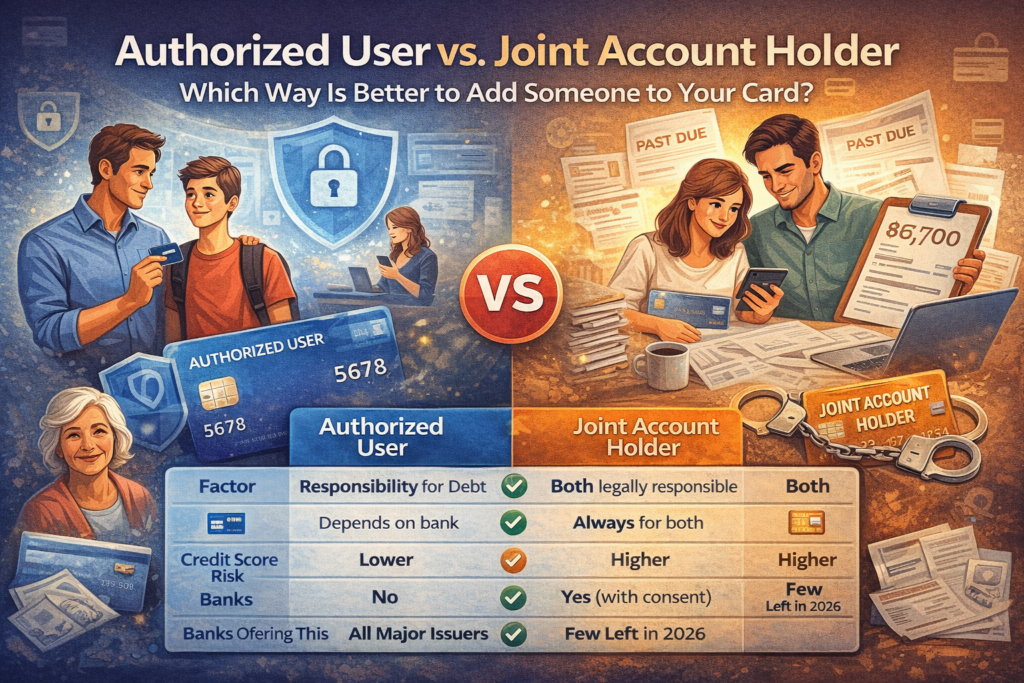
Many families assume all “shared” credit cards work the same way. They don’t. The difference between an authorized user and a joint account holder can affect credit scores, legal responsibility, and even debt collection.
What’s the Actual Difference?
Authorized User
An authorized user (AU) is someone you allow to use your credit card.
Key facts:
- They can make purchases.
- They are not legally responsible for the debt.
- The primary cardholder is 100% responsible.
- The account may appear on their credit report (depending on the bank).
- They can usually be removed at any time.
Joint Account Holder
A joint account holder is a co-owner of the credit card.
Key facts:
- Both people are legally responsible for the debt.
- The account appears on both credit reports.
- Both parties can be pursued for payment.
- Closing the account usually requires cooperation.
Why joint accounts are rare today
According to CFPB data (2025), only 4 major U.S. issuers still offer new joint credit card accounts, down from 12 in 2015.
Why banks stopped offering them:
- Higher default risk
- Legal disputes between co-holders
- Complex account management
Today, most major issuers prefer the authorized user model.
How Credit Scores Are Affected
According to Experian (2025):
- Authorized user accounts can affect credit scores in as little as 30–60 days.
- The impact depends on:
- Payment history
- Account age
- Credit utilization
FICO and VantageScore treat AUs differently:
- FICO 8: May ignore AU accounts that appear suspicious or unrelated.
- FICO 9: More likely to include legitimate AU accounts in scoring.
A Bankrate 2025 study found that consumers added as authorized users to long-standing accounts saw score increases of 20–60 points within three months.
Side-by-Side Comparison
| Factor | Authorized User | Joint Account Holder |
|---|---|---|
| Responsibility for debt | Only primary holder | Both legally responsible |
| Appears on credit report | Depends on bank | Always for both |
| Affects added person’s score | Yes (if reported) | Yes |
| Affects primary holder’s score | No | Yes |
| Can close account | No | Usually requires both |
| Banks offering this in 2026 | All major issuers | Very few |
| Risk for primary holder | Medium | Very high |
| Risk for added person | Low | High |
Scenario 1: Teenager or Young Adult Building Credit
This is the most common use case.
Authorized user is the obvious choice.
Why:
- Builds credit history early
- No legal debt responsibility
- Easy to remove if needed
Banks that report authorized users
Most major issuers report AUs to credit bureaus:
- Capital One
- Chase
- American Express
- Citi
- Discover
Some smaller credit unions and older Barclays products may not report.
Minimum age requirements
Typical policies:
- Amex: 13 years old
- Capital One: no minimum listed
- Discover: 15
- Citi: 18 in some cases
Smart strategy
- Add the teen as an authorized user.
- Let them use the card for small purchases.
- Pay the balance in full every month.
- Remove them if spending becomes an issue.
Scenario 2: Spouses With Separate Finances
Many couples want a “shared” card.
But true joint accounts are rare.
Safer alternative
Each spouse:
- Keeps their own credit card
- Adds the other as an authorized user
Benefits:
- Credit profiles stay separate
- Easier financial independence
- Less risk during divorce
When joint accounts still exist
Some:
- Community banks
- Credit unions
But these come with real risk:
If one spouse racks up debt,
both credit scores suffer.
Scenario 3: Elderly Parent Who Needs Help
This is a delicate situation.
The safest option is usually:
Authorized user only.
Why:
- The parent is not legally responsible
- You maintain full control of payments
- Easy to remove later
Hidden danger
Some banks automatically send a card to the authorized user.
If the parent:
- Uses the card heavily
- Doesn’t understand the balance
You’re responsible for the debt.
Safer alternatives
Consider:
- Prepaid debit card
- Joint checking account with debit card
- Spending-controlled AU card
Scenario 4: Helping a Friend or Family Member With Bad Credit
This is where things get risky.
Authorized user status can:
- Increase their credit score
- Improve their utilization ratio
- Add account history
But there’s a catch.
The risk
If you give them the physical card:
- They can spend freely
- You’re legally responsible
Safer strategy
- Add them as an authorized user.
- Do not give them the card.
- Let the account help their credit history.
Some banks allow this easily.
Example:
- Amex lets you add an AU and set a spending limit.
The Hidden Trap of Authorized Users
Many people misunderstand this part.
You are fully responsible
If the authorized user:
- Spends $5,000
- Without telling you
You still owe the debt.
The bank will not go after them.
Does removing an AU erase their history?
It depends on the scoring model.
- FICO 8: May remove the account from the AU’s report after removal.
- FICO 9: Sometimes keeps the history longer.
In many cases, once removed:
- The account disappears
- The score benefit fades
Divorce and rewards points
If you add a spouse as an authorized user:
- They have no legal right to points or miles.
- All rewards belong to the primary cardholder.
This can become a real issue in separations.
How to Add Someone (Step by Step)
Chase
- Log into your account.
- Go to “Account Services.”
- Click “Add authorized user.”
- Enter their details.
- Chase reports AUs to credit bureaus.
- Typically for users 18 and older.
American Express
- Log into your Amex account.
- Select your card.
- Click “Add Card Member.”
Key advantage:
- You can set spending limits for AUs.
- Minimum age: 13.
Capital One
- Log into your account.
- Go to “Account Settings.”
- Choose “Add Authorized User.”
- Reports to all three credit bureaus.
- Easy to add or remove online.
Citi
- Log into your account.
- Select “Services.”
- Click “Add Authorized User.”
Important:
- You can add someone with or without an SSN.
- Without SSN, credit reporting may not occur.
Discover
- Log into your account.
- Choose “Manage Authorized Users.”
- Add their information.
- Reports AUs automatically.
- Minimum age usually 15.
The Amex Backdating Trick (Bonus)
American Express has a unique benefit.
When you add someone as an authorized user:
- Their credit report may show the original account opening date.
- Not just the date they were added.
This can:
- Increase their average account age
- Boost their credit score faster
Example:
- Card opened: 2018
- Authorized user added: 2026
- Credit report may show: 2018 account date
This is known as the Amex backdating effect.
Final Verdict: Which Is Better?
In most cases:
Authorized user is safer and more flexible.
Choose authorized user if:
- You’re helping a teen
- You’re assisting an elderly parent
- You want flexible family spending
- You want to protect your own credit
Joint accounts only make sense if:
- You fully trust the other person
- You’re comfortable sharing legal debt
- You find a bank that still offers them
For most families in 2026, the authorized user route is the smarter move.
Adding someone to your card is one of the most generous—and potentially dangerous—financial moves you can make.
At SmartCardTip.com, we track which banks report authorized users, which ones let you set spending limits, and how to remove someone without damaging their credit. Check our 2026 issuer guide before you add a single name.
This guide was updated for 2026 by the SmartCardTip.com team. We analyze credit card policies so families can share accounts safely — without sharing debt.