You finally got approved.
Then the card arrived.
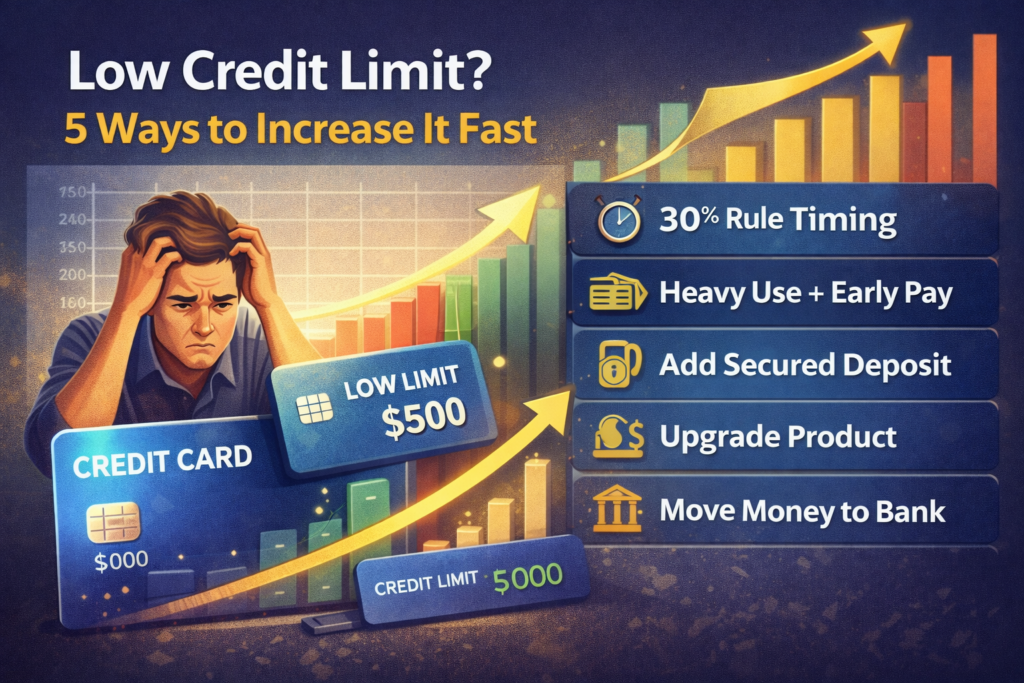
And your limit? $500. Maybe $1,000 if you were lucky.
Enough for groceries—but not for building real credit history.
The good news? You don’t have to wait a year. And you don’t have to beg.
According to Experian’s 2025 Consumer Credit Review, the average starting credit limit for new cardholders is between $500 and $2,000, depending on credit history and income (Experian, 2025). But after six months of consistent usage, many accounts see increases of 25% to 100%.
Meanwhile, FICO reports that credit utilization accounts for 30% of your score, meaning a low limit can actually hold your credit back if you’re not careful (FICO, 2025). And according to NerdWallet (2025), cardholders who keep utilization under 30% are 2.4 times more likely to receive automatic credit limit increases.
The banks are watching your behavior.
If you know what triggers their algorithms, you can force an increase—without ever asking for one.
Method 1: The 30% Rule (Advanced Version)
Most people know the rule:
Keep your utilization under 30%.
But the real secret isn’t how much you spend.
It’s what gets reported to the credit bureaus.
Why banks increase your limit
Banks look for customers who:
- Use the card
- Pay it off
- Appear low-risk on reports
If your reported balance is low, you look safe—even if you spent a lot during the month.
The trigger
Low reported utilization = lower risk profile = higher chance of automatic CLI.
Step-by-step: The “Blue Card” timing strategy
- Check your statement closing date.
- Spend normally during the month.
- 3–5 days before the statement closes, pay most of the balance.
- Let a small balance report—or even $0.
Real example
- Limit: $1,000
- You spend: $800 during the month
- Before statement closes: pay $700
- Reported balance: $100
Your utilization reports as 10%, not 80%.
Do this for 60–90 days, and many banks will trigger an automatic increase.
Method 2: Heavy Usage + Early Payments (The Forced Cycle)
This is how you simulate “high demand” without paying interest.
Why banks increase your limit
Banks want customers who:
- Use the card often
- Generate transaction fees
- Pay reliably
High usage + fast payments = ideal customer.
The trigger
High transaction volume combined with low risk.
Banks think:
“If this person keeps hitting the limit but always pays, they probably need more credit.”
Step-by-step
- Put all daily spending on the card:
- Groceries
- Gas
- Streaming
- When balance hits 30–50% of the limit, pay it down.
- Repeat this cycle 2–3 times per month.
Example
- Limit: $500
- Spend $400 → pay $300
- Spend another $300 → pay $250
- End of month reported balance: $80
You just ran $700–$1,000 in volume through a $500 limit.
Do this for 90 days, and many banks will auto-increase your limit.
Warning: Never spend money you don’t already have.
Method 3: The Depositor Strategy (Secured Cards Only)
If you started with a secured card, your limit is tied to your deposit.
That means you can often increase it instantly—without approval.
Why banks increase your limit
Secured cards carry almost no risk for the bank.
If you deposit more money, they’re happy to raise your limit.
The trigger
Higher deposit = higher limit = lower utilization risk.
Step-by-step
- Log into your card account.
- Look for:
- “Add to security deposit”
- “Increase credit line”
- Add:
- $200
- $300
- or whatever you can afford
Banks that allow this
- Discover secured card
- Capital One secured card
Many allow increases as early as month 2 or 3.
Method 4: Product Upgrade (Without a Hard Inquiry)
This is one of the most overlooked strategies.
Instead of asking for a higher limit, you ask for a different card.
Why banks increase your limit
When you upgrade to a better product:
- The bank re-evaluates your account
- Sometimes assigns a higher limit
- Often without a hard credit pull
The trigger
Internal account review during product change.
Step-by-step
- Wait 3–6 months with perfect payment history.
- Call the number on the back of your card.
- Ask for a product change.
Script you can use
“Hi, I’ve been using this card regularly and paying on time.
I wanted to check if I’m eligible for a product upgrade to another card in your lineup.”
Avoid the phrase “credit limit increase.”
Why this works
- Many upgrades use a soft pull or no pull
- You may receive a higher limit automatically
- No new hard inquiry on your credit
Method 5: Multi-Channel Relationship (The Invisible Force)
Banks reward customers they know well.
If you only have a credit card, you’re just an account number.
If you also have:
- Checking
- Savings
- Direct deposit
…you become a relationship client.
Why banks increase your limit
Internal data shows:
- Your cash flow
- Your balances
- Your stability
According to internal bank policies cited by Bankrate (2025), institutions like Chase and Bank of America review cross-account data every 90 days when considering automatic limit increases.
The trigger
Higher deposits = lower perceived risk.
Banks are more generous with credit to customers who keep money with them.
Step-by-step
- Open a checking or savings account with the same bank.
- Move:
- Your emergency fund
- Or part of your paycheck
- Keep a stable balance for 3–4 months.
This often leads to silent credit limit increases.
What NOT to Do
These mistakes can delay your limit increase for months.
1. Request a CLI in the first 60 days
- Often denied automatically
- May trigger a hard inquiry
- Leaves a negative mark
2. Carry a balance thinking it helps
It doesn’t.
According to the CFPB, revolving balances only increase interest costs and risk signals—not approval odds (CFPB, 2025).
Pay your card in full whenever possible.
3. Close your oldest card after getting a new one
That destroys:
- Your credit history length
- Your average account age
- Your utilization ratio
Keep old accounts open.
Bank Comparison: Who Raises Limits Faster?
| Bank | Algorithm CLI | Secured → Unsecured | Product Change | Secret Tip |
|---|---|---|---|---|
| Capital One | Every 3–4 months | 6–8 months | Limited | Use the pre-approval tool |
| Discover | Every 2–3 months | 7–10 months | Excellent | Cashback match in year one |
| Chase | Strict, 6–12 months | No secured | Good (Sapphire) | Checking account helps a lot |
| Amex | Day 61 + 6 months | No secured | Excellent | 3x CLI on day 61 |
| Citi | Slow, 8–12 months | No secured | Weak | Avoid early requests |
Bonus: The Amex 3x Rule
This is one of the most famous credit limit strategies.
With American Express:
- You can request a CLI on day 61
- Up to 3× your original limit
Example:
- Starting limit: $2,000
- Day 61 request: $6,000
If approved, you triple your limit in two months.
Who qualifies
- Perfect payment history
- Stable income
- Low utilization
Risk
- If your income doesn’t support the new limit, they’ll decline it.
Final Thoughts
Your credit limit isn’t fixed.
It’s a signal.
If the bank sees:
- High usage
- Perfect payments
- Low reported balances
- Strong relationship
…your limit usually rises automatically.
No forms.
No awkward phone calls.
No begging.
Your limit isn’t your destiny. It’s just your starting line.
At SmartCardTip.com, we track which banks are giving automatic increases right now — and which ones are stingy. Check our 2026 CLI database before your next statement closes.
This guide was updated for 2026 by the SmartCardTip.com team. We analyze credit limit patterns and bank algorithms so you don’t leave free credit on the table.