For years, the debate has sounded simple:
Miles are exciting. Cashback is boring.
But the real question isn’t emotional. It’s mathematical.
In 2026, the difference between miles and cashback comes down to how you redeem, how you travel, and how much your time is worth. Most blogs show the fantasy scenario. This guide shows the actual return on your dollar.
Step 1: Calculate Your True Earning Rate
The first mistake people make is comparing percentages without converting them into real dollar value.
Cashback math
Simple.
2% cashback = $0.02 per dollar.
No conditions. No strategy.
Miles math
According to AwardWallet’s 2026 valuations, the average transferable mile is worth about 2.0 cents—but only if you redeem strategically.
Most people don’t.
Realistic earning comparisons
| Scenario | Earn Rate | Value per Mile | Value per Dollar Spent |
|---|---|---|---|
| Cashback 2% flat | 2% | N/A | $0.0200 |
| Miles 2x everywhere (1¢ redemption) | 2 miles | $0.01 | $0.0200 |
| Miles 2x everywhere (1.5¢ redemption) | 2 miles | $0.015 | $0.0300 |
| Miles 2x everywhere (2.5¢ redemption) | 2 miles | $0.025 | $0.0500 |
| Capital One Duo (3x food + 2x other) | 2.4x avg | $0.02 | $0.0480 |
The Capital One Duo (Venture X + SavorOne) allows grocery and restaurant purchases to earn 3 miles per dollar, which can translate to ~6 cents per dollar if redeemed optimally. [citation:3]
That’s the upside.
But now comes the reality.
Step 2: Understand the “Redeeming Gap”
The biggest secret in the miles world:
Theoretical value ≠ real value.
AwardWallet’s 2026 valuations show the difference between average, economy, and business-class redemptions:
| Program | Average Value | Economy Value | Business Value |
|---|---|---|---|
| Delta SkyMiles | 1.34¢ | 1.21¢ | 2.39¢ |
| American Airlines | 2.56¢ | 1.69¢ | 3.86¢ |
| United MileagePlus | 1.98¢ | 1.76¢ | 3.21¢ |
| Alaska | 2.15¢ | 1.73¢ | 4.14¢ |
| Avianca LifeMiles | 2.85¢ | 1.80¢ | 3.91¢ |
| Virgin Atlantic | 3.62¢ | 2.03¢ | 5.84¢ |
| British Airways | 2.55¢ | 1.66¢ | 3.26¢ |
The reality:
- 80% of users never reach business-class redemption values.
- Economy redemptions are often 30–50% lower than the headline numbers.
- Gift cards and merchandise often give under 0.8¢ per point—a terrible deal. [citation:6]
Self-assessment question
Have you redeemed an international business-class flight in the last 12 months?
- If yes: miles may be worth 3–5¢.
- If no: your miles are likely worth under 1.8¢.
In that case, cashback may be the smarter strategy.
Step 3: Apply the Travel Intent Test
This is the real dividing line.
Question:
Would you travel on non-ideal dates to a flexible destination in the next 12 months?
Scenario A: Flexible traveler → Miles win
You:
- Can fly midweek
- Choose destinations based on availability
- Book 6+ months in advance
- Use partner airlines
Miles unlock their full value.
Scenario B: Practical traveler → Cashback wins
You:
- Travel on holidays or weekends
- Need fixed destinations
- Book last minute
- Want simplicity
Cashback is more reliable.
Reality check: award seat availability
Airlines release very few award seats during peak periods.
During major holidays like Thanksgiving and Christmas,
award availability is often zero on popular routes. [citation:4]
Real-life comparison
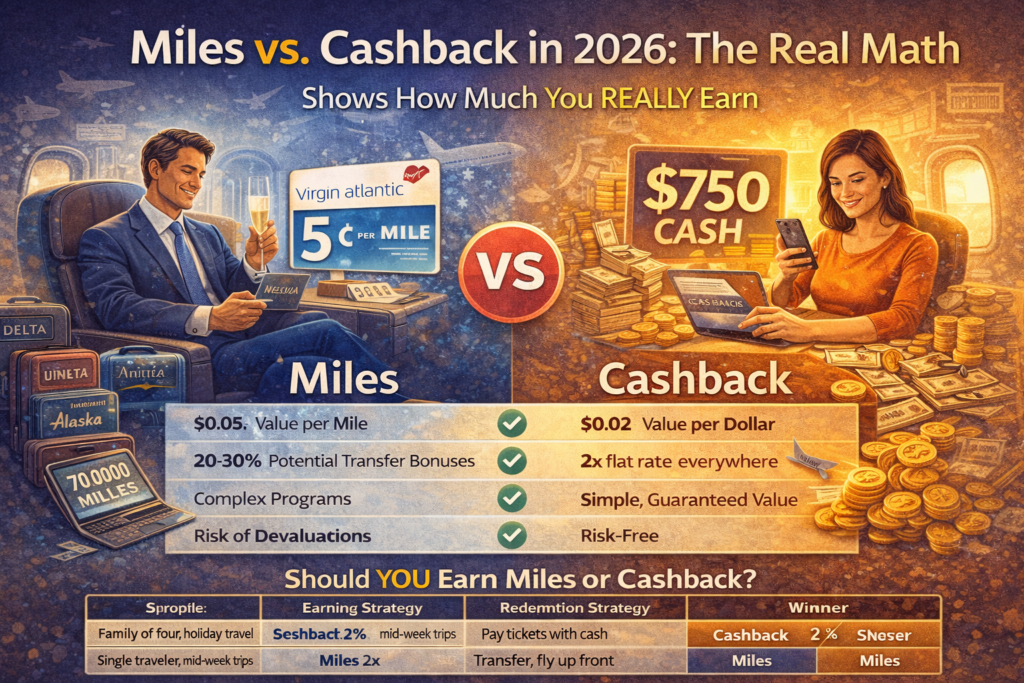
| Profile | Earning Strategy | Redemption Strategy | Winner |
|---|---|---|---|
| Family of four, travels at Christmas | Cashback 2% | Pay cash tickets | 🏆 Cashback |
| Single traveler, flexible dates | Miles 2x | Business-class via partners | 🏆 Miles |
| Small business owner, frequent travel | Hybrid | Miles for leisure, cash for business | 🏆 Tie |
Step 4: Calculate Your Stress-Weighted ROI
This is where most “miles vs cashback” articles fall apart.
They ignore the mental cost.
Mental transaction cost
Cashback:
- Spend money
- Get money back
- Done
Mental cost: $0
Miles:
You must:
- Learn multiple airline programs
- Track transfer bonuses
- Search award space
- Avoid fuel surcharges
- Monitor expiration
Mental cost: HIGH.
The time-value question
Would you spend 10 hours per year learning airline programs to save $300?
If your time is worth $50/hour:
- Time cost: $500
- Savings: $300
- Net result: –$200
You didn’t save money.
You lost it.
The stress-weighted ROI formula
(Redemption Value – Time Cost) ÷ Total Spend = Real Return
Where:
- Redemption Value = points × cents per point
- Time Cost = hours spent × hourly value
- Total Spend = annual card spending
Table: The Real Value of Your Dollar in 2026
| Scenario | Annual Spend | Strategy | Annual Reward | Effort | Verdict |
|---|---|---|---|---|---|
| Family, 2 kids, Christmas travel | $40,000 | Cashback 2% | $800 cash | None | 🏆 Cashback |
| Single professional, flexible travel | $35,000 | Miles strategy | 70k points ≈ $1,400+ | High | 🏆 Miles |
| Retiree, off-season travel | $30,000 | Miles | 60k ≈ $1,200+ | Medium | 🏆 Miles |
| Online shopper, no travel | $25,000 | Cashback 1.5% | $375 | None | 🏆 Cashback |
| Small business owner | $100,000 | Hybrid | $2,000 + trips | Medium | 🏆 Tie |
The 2026 Verdict: When Each Strategy Wins
Miles win if:
- You fly international business or first class.
- You have full flexibility on dates and routes.
- You treat miles as a hobby.
- You use 20–30% transfer bonuses. [citation:3]
In premium redemptions, value can reach 4–8¢ per mile. [citation:5]
Cashback wins if:
- You travel domestically in economy.
- You travel during peak holidays.
- You want simplicity.
- You’d rather invest or spend the cash.
The hidden risk: devaluations
Cashback is fixed.
Miles are not.
In January 2026, Capital One reduced transfers to Emirates from 1:1 to 2:1.5—a 25% value loss overnight. [citation:3]
Cashback never gets devalued.
The Hybrid Strategy: Best of Both Worlds
If you spend more than $40,000 per year, the answer isn’t either/or.
It’s both.
Recommended 2026 setup
Card 1: 2% cashback card
Use for:
- Bills
- Utilities
- Miscellaneous purchases
Card 2: Miles card with bonus categories
Use only for:
- Dining
- Groceries
- Travel
Example: Capital One Duo
- SavorOne: 3% on groceries and dining
- Cashback converts to miles via Venture X
- Effective earning: 3 miles per dollar
- Potential value: ~6¢ per dollar if optimized. [citation:3]
That’s where miles beat cashback—in specific categories, not everywhere.
Final Thoughts
The miles vs cashback debate isn’t about loyalty programs or shiny metal cards.
It’s about:
- Your travel habits
- Your flexibility
- Your time
- Your priorities
Miles can deliver extraordinary value—but only for people willing to play the game.
Cashback delivers predictable value—without the complexity.
At SmartCardTip.com, we don’t sell fantasy redemptions.
We show you the real math, with 2026 data, so you can stop guessing and start earning what’s actually yours.