You pull into the pump. The screen lights up: $3.68 per gallon.
You do the math in your head and immediately regret that last road trip.
According to the U.S. Energy Information Administration (EIA), the average U.S. gasoline price hovered around $3.60–$3.80 per gallon in early 2026, depending on the region (EIA, 2026). That means the typical driver is spending serious money at the pump.
In fact, AAA estimates the average American driver spends about $2,000–$2,300 per year on gasoline (AAA, 2026).
Now picture this:
You’re at the pump.
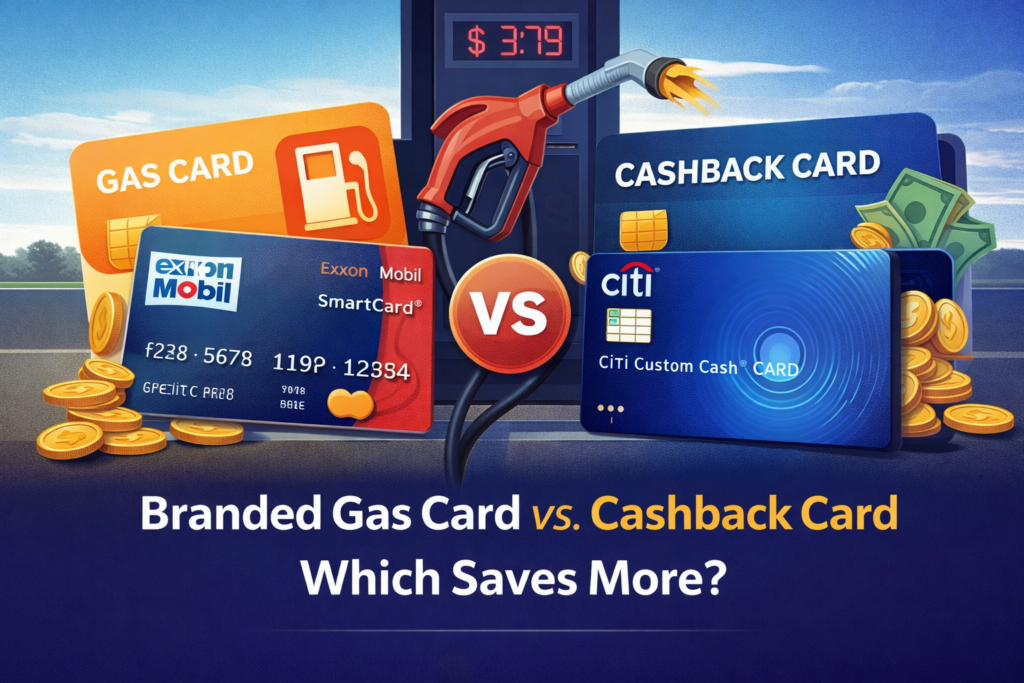
In your left pocket, a branded gas card.
In your right pocket, a generic cashback credit card.
Which one actually saves you more?
Let’s break it down with real numbers.
How Much Gas Are Americans Actually Buying?
Before comparing cards, it helps to understand the scale.
- The average American drives about 13,500 miles per year (Federal Highway Administration).
- The typical car gets around 24–26 miles per gallon (U.S. Department of Energy).
- That equals roughly 520–560 gallons per year.
At $3.70 per gallon:
550 gallons × $3.70 = $2,035 per year in gas.
That’s a major expense—often the second-largest household transportation cost after car payments (Consumer Reports, 2025).
A) Branded Gas Station Credit Cards
These are cards tied to specific fuel brands:
- Shell
- Exxon
- BP
- Chevron
- Circle K
How they work
They usually offer:
- Immediate discount per gallon
- Or points that convert into fuel savings
Typical savings:
- 5¢ to 10¢ per gallon
- Sometimes higher with promotions
Pros of Branded Cards
- Instant discount at the pump
- Often no annual fee
- Extra rewards for in-store purchases
- Simple to understand
Cons of Branded Cards
- Only works at that brand’s stations
- Base gas price may be higher
- Rewards tied to convenience store spending
- Limited flexibility
Real-world example
Shell Fuel Rewards:
- Up to 10¢ per gallon discount
- Works only at Shell stations
Exxon Mobil Smart Card:
- About 6¢ per gallon
- 3% back in store purchases
B) Generic Credit Cards with Gas Cashback
These are standard credit cards that give rewards at any gas station.
Examples:
- Citi Custom Cash
- Chase Freedom Flex
- Amex Blue Cash Preferred
- Abound Credit Union Visa
How they work
They give:
- 2–5% cashback
- As statement credit or points
- Valid at any gas station
Pros of Generic Cards
- Works anywhere
- Not tied to one brand
- Cashback on full purchase
- More flexible spending
Cons of Generic Cards
- No instant pump discount
- Cashback usually comes later
- Some have spending caps
- Rotating categories require tracking
Side-by-Side Comparison
| Card | Type | Cashback/Discount | Annual Fee | Valid In | Best For |
|---|---|---|---|---|---|
| Shell Fuel Rewards | Branded | Up to 10¢/gal | $0 | Shell | Drivers near Shell |
| Citi Custom Cash | Generic | 5% (up to $500/mo) | $0 | Any station | Simple high cashback |
| Abound CU Visa | Generic | 5% | $0 | Any station | Credit union members |
| Exxon Mobil Smart Card | Branded | 6¢/gal + 3% store | $0 | Exxon/Mobil | In-store buyers |
| Chase Freedom Flex | Generic | 5% (rotating) | $0 | Any station | Category planners |
Real Math: Branded vs Generic
Let’s use a real example.
Assume:
- You buy 15 gallons
- Average gas price: $3.70
- Total: $55.50
Branded card
10¢ per gallon discount:
15 × $0.10 = $1.50 saved
New total: $54.00
Effective savings:
$1.50 ÷ $55.50 = 2.7%
Generic card at 5% cashback
5% of $55.50:
$2.78 cashback
Effective savings: 5%
In this scenario, the generic card wins.
The Trap: Is the Base Price Higher?
Here’s the part many drivers miss.
According to Consumer Reports (2025), major-brand stations often charge 5¢ to 15¢ more per gallon than independent stations or warehouse clubs.
Let’s compare:
Scenario 1: Branded station
- Price: $3.80 per gallon
- 10¢ discount
- Effective price: $3.70
Scenario 2: Independent station
- Price: $3.60 per gallon
- 2% cashback
- Effective price: $3.53
Even with a discount, the branded card still costs more.
Break-even point
If a branded station is:
- 10¢ more expensive
- And your card gives 10¢ off
You’re just breaking even.
If the price gap is larger, the generic cashback card wins.
What If You Don’t Have a Branded Station Nearby?
This is common in:
- Rural areas
- Suburbs
- Small towns
If the nearest Shell or Exxon is:
- 10–20 minutes away
- Or off your normal route
You’re burning gas just to get the discount.
In these cases:
Generic cashback cards almost always win.
They let you:
- Choose the cheapest station
- Use warehouse clubs
- Take advantage of price-shopping apps
Warehouse Clubs: The Silent Winner
According to AAA (2026), warehouse stations like:
- Costco
- Sam’s Club
…often sell gas 20–30¢ cheaper per gallon than major brands.
That difference alone beats most branded card discounts.
Example:
- Costco: $3.40
- Shell: $3.70
- Difference: 30¢ per gallon
Over a year (550 gallons):
550 × $0.30 = $165 saved
That’s more than most gas card rewards.
The Hackers’ Approach
Some drivers combine strategies for even bigger savings.
Strategy 1: Buy gas gift cards at supermarkets
Example:
- Use a card that earns 4x points at grocery stores
- Buy a $100 gas gift card
- Use it at the pump
You earn rewards at the grocery rate, not the gas rate.
Strategy 2: Stack cashback apps
Popular apps:
- Upside (GetUpside)
- GasBuddy
- Checkout apps
These can add:
- 5¢ to 25¢ per gallon cashback
And they stack with your credit card rewards.
Example:
- 5% credit card cashback
- 15¢ per gallon from an app
Now your total savings are much higher than a branded card alone.
So Which Strategy Actually Wins?
Here’s the honest breakdown.
Branded cards win if:
- You always use the same brand
- The price is competitive
- The station is convenient
Generic cashback cards win if:
- You compare gas prices
- You use different stations
- You drive in multiple areas
Warehouse clubs win if:
- You have Costco or Sam’s Club nearby
- You fill up regularly
In many cases, cheap gas + small cashback beats expensive gas + big rewards.
The Golden Rule
Use this simple decision guide:
- Always use the same station with good prices?
→ Branded card can work. - Shop around for the cheapest gas?
→ Generic cashback card is better. - Have Costco or Sam’s Club nearby?
→ That’s usually the real winner.
Final Thoughts
Most drivers focus on reward percentages.
But the price per gallon matters more than the rewards.
A 5% card at an expensive station often loses to a 2% card at a cheaper one.
Not sure which cashback strategy fits your driving habits?
At SmartCardTip.com, we break down the numbers so you keep more money in your tank — and your wallet. Compare the top gas rewards cards updated for 2026 here.
This guide was updated for 2026 by the SmartCardTip.com team. We analyze dozens of credit card offers weekly so you don’t waste a drop of cashback potential.