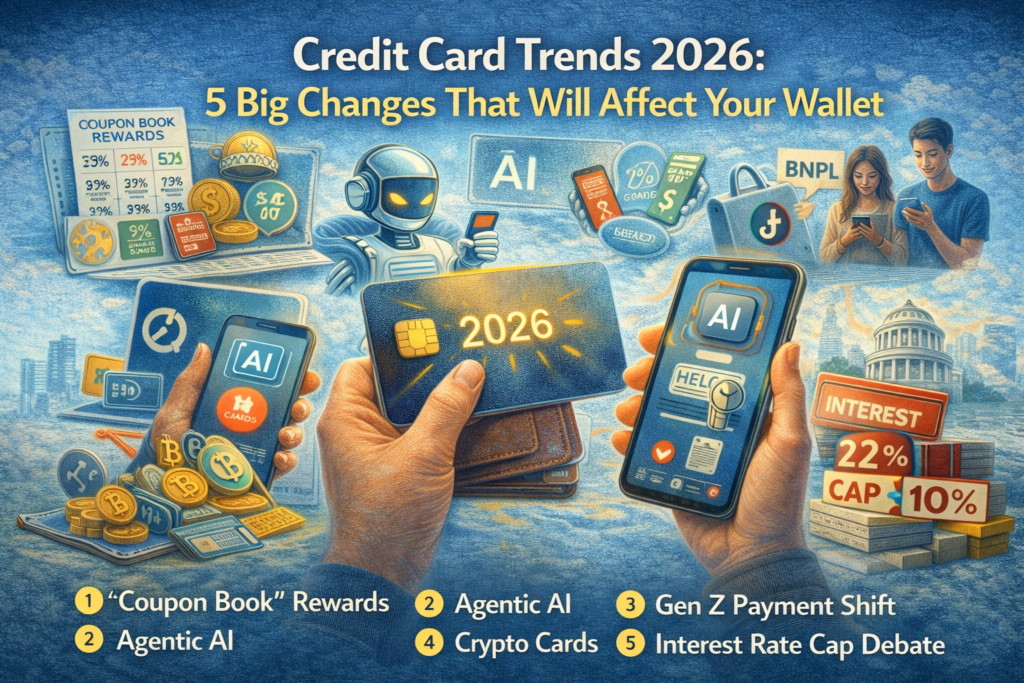
Last year was kind of a lot. The labor market cooled. Interest rates stayed high, hovering around 22% all year. A major consumer watchdog was neutered. And a massive merger created the largest credit card issuer in the U.S. Now we’re a few weeks into 2026, and it’s not looking any less dramatic. From rewards programs that feel like a math exam to AI agents that might soon pay your bills, the credit card landscape is shifting beneath our feet. Here are the five biggest trends that will affect your wallet this year — and what you can do about them.
Trend #1: The Age of “Coupon Book” Rewards
What’s happening
As consumers squeeze more value out of rewards, card issuers are facing higher costs. Their response has been to make rewards programs more complex.
In 2025, companies like Chase and American Express rolled out major updates to flagship cards, including higher annual fees and more layered benefits. Triple-digit annual fees are now common, even for midtier cards.
At the same time, perks are increasingly tied to:
- Monthly credits
- Specific merchants
- Limited-time promotions
- App-based activations
These benefits can offset fees—but only if you actively use them.
The Bilt example
In January 2026, fintech company Bilt, known for its rent-rewards card, launched three new cards with unusually complex reward structures.
These cards introduced:
- Two separate reward currencies
- Different redemption paths
- Options to convert one currency into another
Industry analysts described the system as the credit card equivalent of a math exam you forgot to study for.
What this means for you
Rewards are no longer passive.
You can’t:
- Sign up
- Use the card casually
- Expect to get full value
Now, you often need to:
- Track monthly credits
- Monitor redemption values
- Actively manage benefits
Points are also becoming more dynamic. Some programs now offer variable redemption rates depending on when and how you use them.
Takeaway: If you have a rewards card, you can’t just set it and forget it. You need to actively track perks and redemption values—or risk leaving money on the table.
Trend #2: Agentic AI Is Coming for Your Wallet
Artificial intelligence has been part of credit cards for years. It helps with:
- Fraud detection
- Credit approvals
- Customer service
But a new type of AI is emerging: agentic AI.
What is agentic AI?
Agentic AI is software that can act on your behalf within certain rules. Think of it as a personal financial assistant that can:
- Pay bills
- Book travel
- Compare deals
- Manage rewards
- Make purchases automatically
You set the rules. The AI handles the execution.
What the major players are doing
The biggest payment networks and tech companies are already building these systems.
- Mastercard launched Agent Pay in 2025 and is working with Microsoft to integrate it into AI checkout systems.
- Visa introduced Intelligent Commerce, laying the foundation for AI-driven payments.
- Google is developing a Universal Commerce Protocol to let AI agents interact with merchants across platforms.
By 2030, industry leaders expect a large percentage of customer interactions to be handled by AI.
Real-world examples
Here’s what agentic AI could do:
- “Buy me a baseball ticket when the price drops below $150.”
- “Plan a trip, book flights and hotels, and pay when it meets my budget.”
- “Monitor my rewards and redeem them for the best value automatically.”
This could be especially useful as rewards programs grow more complex.
What this means for you
Agentic AI could:
- Reduce the effort needed to manage credit cards
- Help optimize rewards
- Automate financial decisions
But it also raises questions about:
- Data privacy
- Security
- Trust in automated systems
Takeaway: Agentic AI could finally make complex rewards manageable—but only if you trust the agents. Expect these tools to roll out gradually through your bank’s app.
Trend #3: Gen Z Takes Over — and They Pay Differently
In 2026, Gen Z is no longer the “future consumer.” They’re here now, approaching age 30 and becoming the dominant young-adult demographic.
And they don’t pay the way older generations did.
The rise of the “payment-fluid” consumer
According to Gen Z finance experts, younger consumers don’t stick to one payment method.
Instead, they move fluidly between:
- Credit cards
- Debit cards
- Digital wallets
- Peer-to-peer apps
- Buy Now, Pay Later (BNPL)
They choose whatever option offers:
- The best deal
- The most convenience
- The most flexibility
Economic pressure has made them strategic shoppers by necessity.
The numbers behind the shift
Data from the 2025 holiday season shows:
- 35% of Gen Z shoppers used BNPL
- 25% of millennials did the same
- 13% of Gen X
- Only 6% of boomers
Gen Z is also heavily influenced by social commerce.
Instead of browsing stores:
- They discover products on social media
- Click links directly from content
- Complete purchases in seconds
What this means for you
The traditional model of:
- One main credit card
- One loyalty program
- One payment method
…is fading.
Rewards programs now have to compete with:
- BNPL convenience
- Digital wallets
- Instant checkout experiences
Takeaway: If you’re not Gen Z, watch how they pay—it’s a preview of where the entire market is heading.
Trend #4: Crypto Cards Are Back — and HELOC Cards Are Here
Alternative credit products are making a comeback, but with a different shape than before.
The return of crypto cards
Crypto-linked credit cards surged in popularity around 2021. Then the crypto market crashed, and many of these products disappeared between 2022 and 2024.
In 2025, they began returning.
Why?
New legislation created clearer rules for stablecoins and crypto-based payments. This gave companies the confidence to reenter the market.
This time, the companies offering these cards:
- Are larger
- Have more stable user bases
- Focus on long-term sustainability
The rise of HELOC-backed cards
Even more interesting is a new category: HELOC credit cards.
These cards are tied to a home equity line of credit instead of being unsecured.
Startups like Aven and Trovy are offering products that:
- Use your home equity as collateral
- Provide credit card-like access to funds
- Avoid refinancing your primary mortgage
The pitch is simple:
Many homeowners locked in mortgage rates around 3%. Today’s rates are much higher. Instead of refinancing, these cards let them tap into their equity without losing their low-rate mortgage.
What this means for you
These new products expand the credit landscape.
Crypto cards:
- Appeal to digital asset users
- Tie rewards or payments to crypto ecosystems
HELOC cards:
- Appeal to homeowners
- Offer lower rates than unsecured credit
- Come with higher stakes, since your home is involved
Takeaway: New products mean new opportunities—but also new complexity. Understand what’s backing your credit before you swipe.
Trend #5: The 10% Interest Rate Cap — Popular Idea, Messy Reality
One of the biggest policy debates in 2026 centers on credit card interest rates.
What’s being proposed
There is growing support for a temporary cap on credit card interest rates at 10%.
Proposals in Congress suggest:
- A one-year cap
- Or a five-year cap, depending on the bill
The idea is politically popular.
Americans with revolving credit card debt owe an average of $11,413, and nearly half expect their balances to grow in 2026.
The argument in favor
Supporters say:
- A $10,000 balance at 22% APR generates about $2,200 in interest annually.
- At 10% APR, that drops to $1,000.
- That’s a savings of roughly $1,200 per year.
Americans paid about $160 billion in credit card interest in 2024, a 50% increase since 2022.
Many households now use credit cards to pay for:
- Groceries
- Medical expenses
- Rent or utilities
The argument against
Opponents argue that credit cards are unsecured loans, which carry higher risk.
They warn that a 10% cap could lead to:
- Lower credit limits
- More rejected applications
- Reduced access for subprime borrowers
- Fewer rewards and perks
Some economic research suggests a 15% cap might be a more balanced solution.
What this means for you
If you pay your balance in full:
- Interest rate caps won’t affect you directly
- But rewards programs might shrink
If you carry a balance:
- A cap could reduce your interest costs
- But only if you still qualify for credit
Takeaway: This isn’t settled. Watch what happens in Congress, but don’t base your financial plans on a rate cap that may never arrive.
Bonus Trend: Rising Delinquencies and the Two-Tier Economy
Behind the flashy new products and AI tools, the data tells a more sobering story.
What the numbers show
Recent industry data reveals:
- 30+ day delinquency rates remained above pre-pandemic levels in 2025.
- About 15% of cardholders are making only minimum payments.
- Cure rates dropped to 47.6%, down from 54.7% two years earlier.
- Charge-off rates climbed to 8.8%, up from 5.2%.
These numbers suggest growing financial stress for many households.
The two-tier economy
Analysts describe the current environment as a “two-tier” consumer economy.
Top third of households (income above $100,000):
- Spending freely
- Traveling
- Dining out
- Using rewards aggressively
Bottom third (income below $50,000):
- Relying on credit cards for essentials
- Carrying balances month to month
- Struggling with rising costs
This divide explains why overall spending looks strong, even while many households are under pressure.
What this means for you
If you’re carrying balances:
- You’re not alone
- But the system is built to profit from revolving debt
Takeaway: The best defense is awareness. Know your rates, know your payment timing, and prioritize paying down revolving balances.
Conclusion: How to Navigate 2026
2026 is shaping up to be a year of complexity—complex rewards, complex AI, and complex politics. But the fundamentals haven’t changed.
- Pay your statement balance in full to avoid interest.
- Understand your rewards before you chase them.
- Watch for new tools, like agentic AI, that might simplify your finances.
- Stay informed about policy changes that could affect your wallet.
The credit card landscape is shifting. But with knowledge and good habits, you can navigate it—and come out ahead.
This guide was updated for February 2026 by the SmartCardTip.com team. We track credit card industry trends so you don’t have to—and deliver insights that actually matter for your wallet. Sources: Experian, NerdWallet, CFPB, Mastercard, and industry analysis.