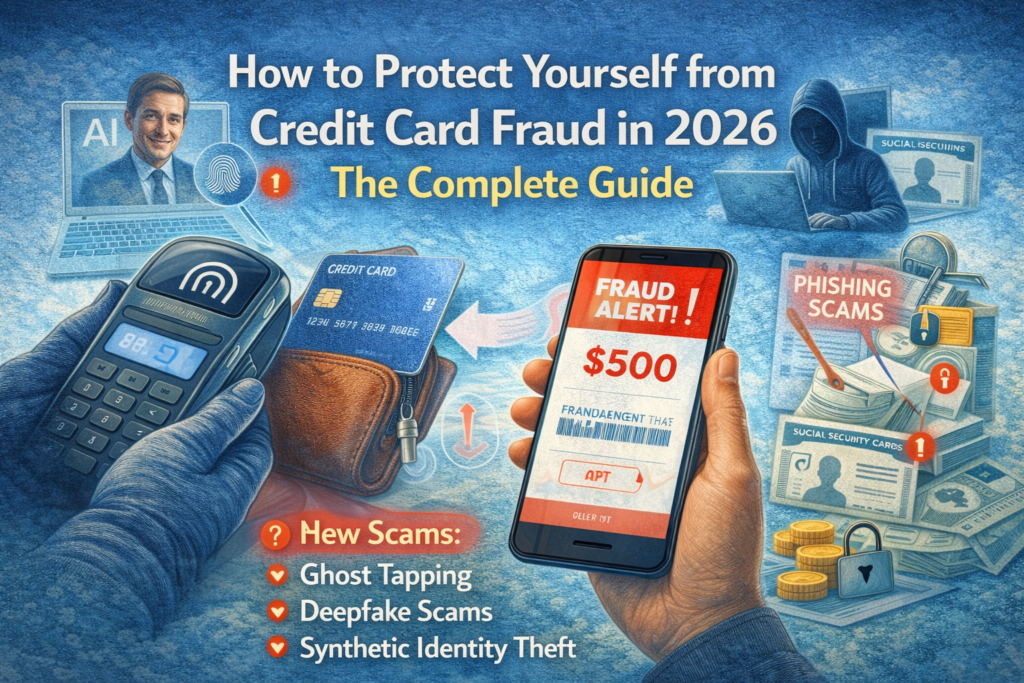
Imagine this: you’re sipping coffee, and your phone buzzes with a notification. A $500 charge at a store you’ve never visited. Your card is in your wallet. You haven’t clicked any suspicious links. Yet, someone just spent your money. You’re now part of a terrifying statistic. Credit card fraud cases jumped 54% year over year from 2024 to 2025, according to recent data. And with artificial intelligence now in the hands of criminals, the threats in 2026 are more sophisticated than ever. But here’s the good news: most fraud is preventable. This guide shows you exactly how to protect yourself.
The 2026 Fraud Landscape: Why You’re at Risk
The numbers tell a clear story. Credit card fraud is rising fast, and the tactics are evolving just as quickly.
The Alarming Increase
More than 1.15 million identity theft cases were reported to the FTC in the first three quarters of 2025 alone. That number already surpassed the total for all of 2024. Among all categories, credit card fraud consistently ranks at the top.
The Role of Artificial Intelligence
More than 50% of modern fraud attempts now involve AI-powered tactics. Criminals use artificial intelligence to:
- Generate convincing phishing emails
- Create realistic fake websites
- Clone voices for scam calls
- Automate large-scale fraud campaigns
These scams are faster, more convincing, and harder to detect than ever before.
The New Profile of the Victim
Contrary to popular belief, seniors are no longer the primary targets.
Adults aged 20 to 29 now represent the largest share of financial losses from fraud, accounting for roughly 44% of reported cases. Younger adults tend to:
- Shop online more frequently
- Use digital wallets and contactless payments
- Respond quickly to texts and emails
These habits create more opportunities for scammers.
The Financial Cost
Consumer fraud losses reached $12.5 billion in 2024, a 25% increase from the previous year. That figure includes:
- Card fraud
- Identity theft
- Online scams
- Social engineering attacks
The trend shows no sign of slowing down in 2026.
The New Scams You Need to Know in 2026
Understanding the threats is the first step to avoiding them. Here are the most dangerous scams circulating right now.
Ghost Tapping
Fraudsters now use portable NFC devices to steal money just by standing close to you in a crowd.
They don’t need your card physically. They only need proximity to:
- Your contactless card
- Your digital wallet
With a quick tap near your pocket or purse, they can trigger a small unauthorized charge that may go unnoticed.
Phantom Payments
This is one of the most common fraud techniques.
Criminals:
- Test stolen card numbers
- Make tiny charges, sometimes just a few cents
These “phantom payments” often go unnoticed. If the transaction succeeds, the fraudster knows the card is active and ready for larger purchases.
AI-Powered Phishing and Deepfakes
In the past, scam emails were easy to spot. Poor grammar, strange links, obvious red flags.
Not anymore.
In 2026, criminals use AI to create:
- Perfectly written emails
- Realistic text messages
- Voice calls that sound exactly like your bank or a family member
Some deepfake voice scams can replicate a loved one’s voice, claiming an emergency and asking for money.
One-Time Passcode Scams
This is one of the fastest-growing threats.
Here’s how it works:
- A scammer calls, pretending to be your bank.
- They claim there’s suspicious activity.
- They say they need to “verify your identity.”
- They send a one-time passcode to your phone.
- They ask you to read the code back to them.
Once you share that code, they can:
- Access your account
- Change your login details
- Lock you out completely
Synthetic Identity Theft
This is the fastest-growing type of financial crime.
Criminals create fake identities using:
- Real Social Security numbers
- Fake names and addresses
They build credit slowly over months or years. Then, they max out credit lines and disappear. By the time the fraud is discovered, there’s no clear victim to report it.
The 7 Essential Habits to Block Fraud
Protection isn’t about one big action. It’s about consistent, small habits that make you a difficult target.
Habit #1: Freeze Your Credit (It’s Free and Powerful)
Your strongest defense is a credit freeze.
A freeze:
- Prevents new accounts from being opened in your name
- Works with all major credit bureaus
- Doesn’t affect your credit score
- Can be lifted anytime
If someone steals your Social Security number, a credit freeze stops them from opening new credit accounts.
Habit #2: Use Virtual Card Numbers for Online Shopping
Many card issuers now offer virtual card numbers inside their apps.
These are:
- Temporary card numbers
- Linked to your real account
- Often single-use or merchant-specific
If the retailer gets hacked, the stolen number becomes useless.
Use virtual numbers for:
- Subscriptions
- New websites
- Online marketplaces
Habit #3: Turn on Real-Time Purchase Alerts
Set your account to notify you of every transaction.
Even:
- $1 charges
- Small subscription renewals
- Gas station holds
If a fraudster tests your card with a tiny phantom payment, you’ll know instantly.
Habit #4: Never Store Your Card Details on Websites
Saving your card for faster checkout is convenient—but risky.
When a retailer gets hacked:
- Stored card data is often exposed
- Fraudsters gain access instantly
Instead:
- Enter your card details manually
- Use digital wallets when possible
- Avoid saving card information on unfamiliar sites
Habit #5: Enable Two-Factor Authentication Everywhere
Passwords alone are no longer enough.
Two-factor authentication (2FA) adds a second layer, such as:
- A text message code
- An authenticator app
- A biometric scan
Enable 2FA on:
- Email accounts
- Banking apps
- Financial websites
- Payment services
Even if someone steals your password, they can’t log in without the second factor.
Habit #6: Use an RFID-Blocking Wallet
To prevent ghost tapping and skimming:
- Use a wallet with RFID-blocking material.
- This creates a shield against radio signals.
- It prevents criminals from reading your card data remotely.
It’s a simple, one-time purchase that protects against an entire category of fraud.
Habit #7: Scan Your Accounts and Credit Reports Weekly
Don’t wait for your monthly statement.
Once a week:
- Log into your accounts
- Check recent transactions
- Look for anything unusual
Also check your credit report regularly. You’re entitled to a free report from each bureau every year.
A sudden drop in your score could be the first sign of fraud.
The Golden Rules of Online and In-Person Safety
Simple habits can block many scams before they start.
For Online Shopping
- Only shop on secure websites with “https://” and a padlock icon.
- Be skeptical of deals that seem too good to be true.
- Never click links in unsolicited emails or texts.
- Type the website address manually into your browser.
For In-Person Transactions
- Check ATMs and gas pumps for loose or unusual card readers.
- Cover the keypad when entering your PIN.
- Never let your card out of your sight at restaurants.
- If possible, pay at the table.
What to Do Immediately If You’re a Victim
If fraud happens, speed matters. Follow this checklist.
- Step 1: Contact your bank or card issuer immediately using the number on the back of your card. Report the fraud and cancel the card.
- Step 2: Request a “wallet wipe.” Ask the bank to remove your old card details from all digital wallets and online accounts.
- Step 3: Change your passwords, especially for email and banking.
- Step 4: Monitor your accounts and credit reports closely.
- Step 5: Report the scam to the FTC and the BBB Scam Tracker.
Fast action limits the damage and helps authorities track fraud patterns.
Conclusion: Vigilance Is Your Superpower
Credit card fraud in 2026 is more sophisticated than ever. But you are not defenseless. The single most effective strategy is awareness.
By understanding the latest scams—from ghost tapping to AI-powered deepfakes—and adopting the simple habits outlined here, you transform yourself from an easy target into a hard one.
You can’t control the hackers. But you can control your defenses.
Make these habits part of your routine. Stay alert. Stay informed. And most importantly, protect what’s yours.
This guide was updated for February 2026 by the SmartCardTip.com team. We believe that protecting your financial life starts with knowledge. Stay informed, stay vigilant, and stay secure.